Showing posts with label #cancerfilm. Show all posts

Monday, September 19, 2016

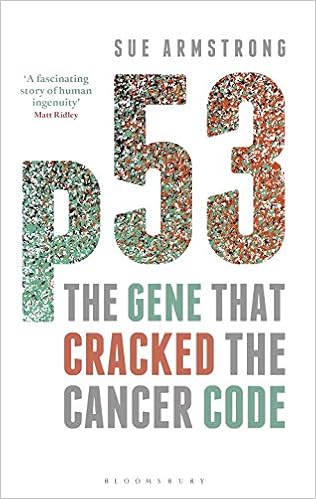
p53: The gene that cracked the cancer code - a review

I wouldn't think that an entire popular science book could be written about one protein, unless that protein is p53. As of this writing, a PubMed search reveals 82,179 scholarly articles about p53. Thus, p53 The Gene That Cracked the Cancer Code by Sue Armstrong has an abundance of source material. Even with the all that information to cover, the author does an excellent job explaining the relevant research in a clear and concise way, using a chronological structure with the main source being interviews with the scientists that did the original research. Unlike many popular science books, Armstrong relies more on the direct quotes from the primary source, ensuring that she gets everything right.

Briefly, p53 (named because the protein is about 53 kilodaltons on a protein gela naming convention that swept through some circles of scientific research, but has since been eclipsed by more colorful naming styles) was discovered in 1979. While David Lane is typically credited first, Arnold Levine, Lloyd Old, and Pierre May also deserve acknowledgement for the discovery. Considered to be a tumor suppressor, p53 has cellular roles in genome stability, DNA repair, apoptosis/cell death, and cell metabolism. This book primarily focuses on p53's role as the "guardian of the genome", a term penned to describe that ability of p53 to keep the cell's DNA free of mutations. This role is the primary connection of p53 to cancer: normally, p53 induces cellular suicide (apoptosis/cell death) in cells with DNA damage. p53 is the most commonly mutated gene in cancer and when p53 is mutated, it loses its ability to protect from DNA damage, which can lead to excessive cell growth, a hallmark of tumorigenesis.

Like so many of the books on cancer that I have covered before, this book hit many of the key topics in the area of cancer research. What is unique about this book is that it leads the reader through the sometimes winding roads of scientific research. This includes an in-depth discussion of the p53 mutation database, which collects all the mutations in p53 that have been linked to a variety of cancers. This database has been a rich source of information for researchers over the years. For example, in 1996 researchers showed that lung cancer cases showed p53 mutations in a particular hotspot on the p53 gene. Interestingly, these same mutations were shown by the Pfeifer lab to be induced by the carcinogenic substance in cigarette smoke, benzopyrene diol epoxide (BPDE). This publication was a major win for the 1998 class action lawsuit against Big Tobacco.

Map of p53 mutations and their frequency.
The p53 database has also helped reveal the link between liver cancer, Hepatitis B, and aflatoxin, a poison produced by a fungus that grows on peanuts and other grains when they are stored without adequate ventilation. Typically, HepB causes liver cancer only after many years. However, in places like Asia and Africa, the risk is compounded by the exposure to aflatoxin, a carcinogen known to cause DNA damage. Aflatoxin can induce a mutation in p53 (at codon 2449), which can essentially turn p53 from a tumor suppressor into an oncogene.

The book delves into several of the most damaging p53 mutations. For example, Li-Frameni syndrome (LFS) is a genetic disordered characterized by the early and frequent acquisition of cancer at "every conceivable site in the body". The disease was first described in the early 1980s, but the connection to p53 was not established until the 1990s. A variety of mutations in p53 have been associated with LFS, but the most common hotspot connected to LFS is involved in p53's ability to bind to DNA.

Perhaps the most interesting story in the book describes the cancer clusters in Brazil. Sue Armstrong contributed the story of "Brazil's Cancer Curse" to Mosaic Science; it is a fascinating story and gives a great sense of her writing style. As discussed in the book Toms River, cancer clusters are typically assumed to be caused by a pollutant. Likewise, the Brazilian doctors wondered if that might be the case. However, the research about LFS was starting to garner attention, leading Brazilian clinicians to suspect p53 was also be responsible in the Brazilian cancer cluster. Indeed, sequencing of the p53 gene in affected individuals reveals a mutation at codon 337 to be the most common. Where the story gets really interesting is when scientists attempt to understand how an uncommon mutation fixed in the population at such high frequency. While the source is still debatable, the p53 mutation is now thought to be the result of a founder effect and bottleneck (as described for BRCA mutations in The Wandering Gene).
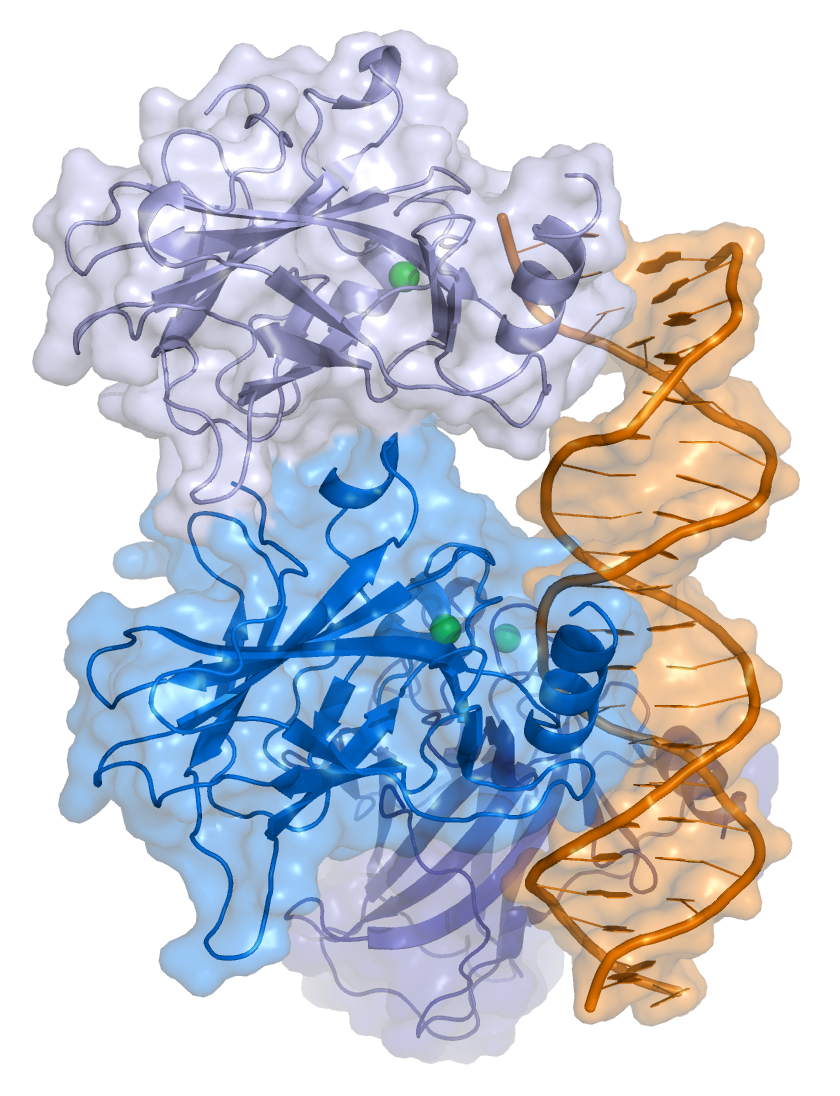
p53 structure (Wikipedia)
I think I learned the most in the section about the clinical approaches to treating p53 mutations. Here, Armstrong has done a deep dive into the literature about the latest drugs and trials connected to p53 function and dysfunction. Thus, the book is up to date on the available p53-related drugs (as of its publication in November 2014). Armstrong describes several different approaches to treating p53-related cancers, including drugs like Advexin, which uses a viral vector to induce cells to express wild type p53. For reasons that are unclear, Advexin has had mixed success in the US and is still awaiting FDA approval. Perhaps more interesting, is the research on PRIMA-1 (an acronym for p53 re-activation and induction of mass apoptosis), a drug designed to work on mutants of p53 that no longer bind DNA. Essentially, PRIMA-1 induces mutant p53 into its wild type shape, allowing it to re-activate and bind DNA. Thus, PRIMA-1 should target a wide range of p53 conformation mutants and leave wild type p53 alone. Both of these have been major roadblocks in the deisng of previous p53 therapies, especially since p53 is at the center of so many regulatory pathways. The drug is currently in Phase 2 trials. (Here, Armstrong takes a tangent into the history of chemotherapy, specifically its connection to the German use of mustard gas in WWII. This was a fascinating story that I recommend reading more about, for example here or here.) 

Sue Armstrong's p53 book distills a large amount of scientific literature into an interesting and readable book. I don't think I would recommend this as the first book to read if you are just starting to learn about cancer research. To me, the best starting place would be The Philadelphia Chromosome (some might recommend Mukherjee's The Emperor of All Maladies). However, this is an excellent book for those familiar with cancer and looking for the next level of science writing on the topic.

Sunday, September 13, 2015

The Emperor of All Maladies - comments on the second part of the PBS special

In all my reading about cancer biology, I have not yet tackled The Emperor of All Maladies, which is said to be the best book on the subject.  Luckily, PBS and Ken Burns have delivered an excellent three-part series based on Siddhartha Mukherjee's 2011 book. This post covers the contents of part two, "The Blind Men and The Elephant."

This part of the series focuses on discovering the cause of cancer. The title, an allusion to the parable, refers to the fact that for many years scientists could not find the connection between the three major causes of cancer: viral, chemical, and genetic. The ideas were separated ideologically and scientifically. At conferences, the scientists that supported each of these ideas did not interact. It was only relatively recently that the connections between these causes were illuminated.

The earliest carcinogen was discovered in 1911 by Peyton Rous, who described the viral origin of avian sarcoma (for more information check out this great story by Jessica Wapner). In 1964, Burkitt lymphoma was linked to the Epstein-Barr virus. These results led to an rapid increase in the focus on viral carcinogenesis with the idea that a vaccine could prevent cancer. This focus came at the cost of other ideas about the causes of cancer. Unfortunately, Human papillomavirus (HPV) and Hepatitis (HepB and C) have been the only other viral carcinogens identified.

The second idea was that chemicals cause cancer. Lung cancers became increasingly common in the late 1940s. Epidemiological studies showed links between cigarette smoking and lung cancer, but tobacco companies obfuscated the results. In 1964, scientific links between cigarettes and lung cancer were firmly established thanks in part to the Kennedy administration's blue ribbon panel tasked with investigating the matter. Once the epidemiological methods were established for tobacco, other chemicals were added to the carcinogen list.

The final idea was that genes caused cancer. The major breakthrough came from Michael Bishop and Harold Varmos, who were studying the Rous sarcoma virus. Their timing was perfect the tools of molecular biology were becoming readily available. Work from their labs led to the discovery of a gene called Src, the first described oncogene. The oncogene idea was that normal genes in our bodies that control cell growth can be turned on at high levels and cause cancer. Robert Weinberg later identified the first human oncogene, Ras. Dozens of other oncogenes were found in subsequent years, leading to optimism that the cure for cancer was surely close at hand. However, we have since learned that cancer is a complex disease (some argue a collection of diseases) with a diverse range of etiologies, which makes it impossible to treat with a one-size-fits-all approach.

Interspersed with the description of cancer research was a narrative of one woman's treatment for breast cancer. This story begins with a history of breast cancer treatment, including a discussion of William Halsted's radical mastectomy. As I covered in more detail in my recent post on Pandora's DNA, Halsted's method was the standard treatment for breast cancer for nearly a century. The success rate was not impressive, but the treatment approach was unchallenged until Bernard Fisher criticized its use. Fisher performed a clinical trial to compare the use of the lumpectomy with the radical mastectomy. In 1985, his results showed that either approach was just as effective, but that the lumpectomy was less invasive and led to improved quality of life. Radical mastectomy was no longer the standard therapy: "cutting more did not mean curing more".

The intention of this segment was to illustrate the personal side of cancer, but for me the link between the two segments was how the treatment of cancer has evolved in parallel with developments in cancer research. This highlights how basic scientific research is a critical starting point for successful clinical outcomes.

Thursday, July 16, 2015

The Emperor of All Maladies - part three of Ken Burns' PBS documentary

In all my reading about cancer biology, I have yet to tackle The Emperor of All Maladies, which is said to be the best book on the subject. Luckily, PBS and Ken Burns have delivered a three-part series based on Siddhartha Mukherjee's 2011 book. Here, I will do a short synopsis of Part Three, "Finding the Achilles Heel", which focuses on the development of cancer therapies.

The documentary begins with the story of Gleevec (covered beautifully in Jessica Wapner's The Philadelphia Chromosome), which was designed specifically to treat a type of chronic myelogenous leukemia (CML) that is caused by a swapping of two chromosomes to create the Philadelphia chromosome. The success of Gleevec led to great hope  could this be the first of many targeted therapeutics? Indeed, there have been some successes in targeted therapies; ALK inhibitors have shown some promise for the treatment of cancers that are characterized by the presence of an ALK gene rearrangement. However, on average, only four targeted therapy drugs are approved per year. These drugs are typically very expensive and are not very successful in terms of extending patients' lives.

The complexity of cancer has been a major obstacle in the development of successful therapeutics. When the human genome was completed in 2001, a new hypothesis arose: if we sequence common cancers and compare with normal cells, we could begin to understand exactly how they differ. In 2005, The Cancer Genome Atlas (TCGA) project began; this large-scale sequencing project aims to identify mutations in 25 different types of commonly occurring cancers. The first results, released in September 2008, confirmed cancer's complexity. Many cancers had multiple mutations in as many as 100 genes. However, there were some cancers that had only a few mutations or showed recurrent mutations, which were found in many different patients. These less complex cancers are the focus of future directions. As more and more cancer genomes are completed, researchers can start to identify patterns in the mutations that appear in cancers; such analyses may lead to the identification of driver mutations (i.e., mutations that are causally linked to oncogenesis) versus passenger mutations (i.e., mutations that are picked up along the way). Mukherjee points out how much drug companies have benefited from the information from basic research. He suggests that the current funding environment, where increased funding of clinical and translational studies comes at the expense of basic research, is not likely to promote these types of success stories in the future.

ACS, anti-smoking ad 1968
The shift in focus from cancer treatment to cancer prevention has generally been a useful approach. For example, smoking was once a major contributor to cancer, but anti-smoking campaigns starting in the late 1960's have successfully reduced the number of new lung cancer cases. Obesity is another major contributor, but solving this health problem has been less straightforward. Viruses like human papilloma virus (HPV) and hepatitis are also common causes for cancers; these viruses are now decreasing in incidence with vaccines for both viruses available. Approximately 40% of cancers are due to unknown causes. Epidemiology focuses on determining a causal link between cancers and environmental factors (e.g., pollution, occupation, cell phones), but the connections are often difficult to prove (as was discussed in Toms River.) Overall, the combination of prevention, early detection, and targeted therapies has decreased the cancer mortality rate 20% in the US over the last two decades.


For me, the most interesting part of the this episode was about cancer immunotherapy. Cellular immunotherapy takes immune cells from a patient's blood, activates these cells, and then gives them back to the patient; this approach boosts the immune system by enriching for T cells. Some researchers have suggested that the immune system is held back from attacking cancer because it is the patient's own cells. In 1992, the FDA approved a therapy using interleukin-2 (IL-2), a protein produced by white blood cells during the immune response. Increasing IL-2 leads to increased T cell response, making T cells more likely to recognize and attack cancer cells. After that initial success, there were few breakthroughs, but some recent developments have increased interest in the field. For example, in 2011 the FDA approved Yervoy (ipilimumab), which binds and blocks CTLA-4, a checkpoint protein that prevents T-cell activation to keep cells from attacking healthy tissue. Thus, when CTLA-4 is blocked, T cells can attack tumors. Both Yervoy and IL-2 treatment show long-lasting responses, but only in a small percentage of patients; serious side effects are also common. The newest weapon in the immunotherapy arsenal is an inhibitor of PD-1, called Opdivo (nivolumab). PD-1 is another checkpoint protein, which some cancers use to disable the T cells in the area surrounding the tumor. PD-1's specificity to cancer cells suggests that Opdivo could be more powerful and less toxic than existing therapies. Based on these exciting developments, this is likely an area to watch in the coming years. 

--------------------------------------------
** You can read more about cancer immunotherapy in this feature in Nature, this Nature review by Ira Mellman, or the April 2015 special issue of Cancer Cell focused on immunotherapy in cancer.