Showing posts with label periodic table. Show all posts

Monday, October 14, 2013

The Poisoner's Handbook and my idea for a new tv show

I just finished reading The Poisoner's Handbook: Murder and the Birth of Forensic Medicine in Jazz Age New York. Similar to Sam Kean's book about the periodic table (The Disappearing Spoon), this book focuses on stories about some rather dangerous and fascinating chemistry. Here, author Deborah Blum culls stories from the Prohibition Era in New York City. Before that time, New York City's police department was poorly run. Then in 1918, Charles Norris was appointed as chief medical examiner (M.E.); Norris was the first M.E. who actually had suitable credentials for the position. Once in the department, Norris brought toxicologist Frank Gettler on board. Together, they helped to establish the role of forensic medicine in the investigation of crimes. Both Gettler and Norris worked countless hours in the laboratory to establish tests for the lethal doses of various poisons; they also investigated some of the more notorious crimes of the Prohibition Era.

Each chapter is focused on a different poison (e.g., radium, methyl alcohol). Blum chooses stories that are all linked to Gettler and Norris and the development of forensic medicine. A few of the chapters focus on what are likely seen as standard poisons, cyanide and arsenic. These poisons were readily available at pharmacies and hardware stores; thus, murders by these methods were almost commonplace. The work of Norris and Gettler established tests to help police convict poisoners who decided to use rat poison to get rid of an irksome husband or mother-in-law.

Of course, because the book focuses on the Prohibition Era, many stories described the effects of methyl alcohol and ethyl alcohol. When alcohol was outlawed in the US, the government decreed that industrial alcohol should increase the percentage of methyl alcohol. This was intended to decrease the chance that the alcohol would be imbibed. Instead, there was a sharp increase in the number of alcohol-related fatalities; these were mostly poor folks who couldn't afford safer alcohol. Blum discusses the chemists who were involved in bootlegging during this time period, which gave me an excellent idea for a new show: Breaking Bad meets Boardwalk Empire. Imagine the mild-mannered chemists like Walter White who found themselves in league with the unscrupulous bootleggers like Nucky Thompson!
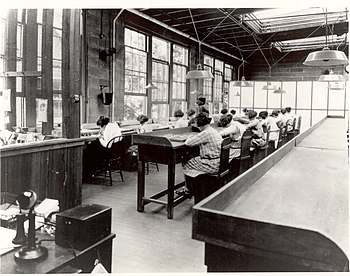


from Wikipedia
The poor policy decisions behind prohibition were responsible for an increasing number of deaths; in addition, the lack of federal oversight of industry was also proving dangerous. For example, one company sold hair depilatories that included thallium; while the product did fulfill its promise of removing unsightly hair, it often made the users blind and eventually killed them. Another heart-breaking story, which I first read about in Radioactive, was that of the radium dial painters. In 1917, the Radium Corporation in Orange, New Jersey employed several young women to paint the faces of watches and other radium-dial instruments for the military. The employees shaped the tips of the paintbrush with their lips to produce the fine point necessary to make the small numbers on the dials. None of the employees found this behavior risky because radium was a popular panacea, which was present in a number of health tonics and spa treatments. Unfortunately, the women all became very ill; by 1924, nine of the dial painters died. The medical examiner in New Jersey (Harrison Martland) consulted with the NYC M.E.s to investigate these illnesses. They found that the living dial painters, called the "Radium Girls" by the press, were exhaling radon gas. The bones of the deceased dial painters were radioactive enough to generate an image on X-ray film and set off a radiation detector. The data gathered by the two groups of medical examiners were critical for the case brought by five of the Radium Girls, who were asking for a settlement from their former employer to help pay their medical bills. In the end, the women received a very small settlement ($10,000 in cash and complete medical care); while it was much less than they originally sought, they were happy to have any money while they were still living. Interestingly, the dial painters all died of aplastic anemia, which was also the cause of Marie Curie's death in 1934. 

Despite the amount of press that the case of the Radium Girls received, products containing radium were still on the market. It wasn't until the death of millionaire Eben Byers in 1931 that the safety of these products was called into question. On the advice of a physician, Byers was regularly drinking a product called "Radithor" for the treatment of an arm pain. The state of Byers' body was similar to those of the Radium Girls. Shortly after Norris and Gettler released the results of their autopsy, the government issued a warning regarding the safety of drugs like Radithor. In 1932, the products were officially banned by the government.

In the final analysis, The Poisoner's Handbook was interesting and included lots of off-beat stories from a strange time. However, its focus is more on history and forensics than chemistry. Thus, I slightly preferred The Disappearing Spoon.  

Wednesday, January 30, 2013

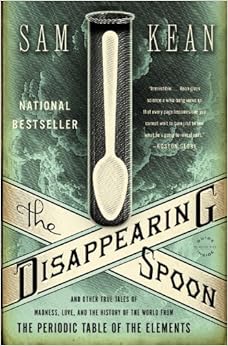
Sam Kean's Disappearing Spoon and my renewed excitement about the periodic table

The Disappearing Spoon by Sam Kean explores the periodic table and the stories behind a variety of elements.  It made me realize how much I had forgotten from my chemistry classes. Of course, it also made me think about how I learned about chemistry in the first place. My high school chemistry teacher, Ms. Simms, was excellent. She had a number of great illustrative methods to think about things like orbitals and electrons. However, despite her superb teaching, I really struggled with chemistry at the time.

My graduate classes in biology always included lots of narratives of the scientific process and how the scientists reached their discoveries. This is a great way to learn about how to think about a problem and how to design experiments properly. It is also an excellent way to learn about science. This book taught me far more about chemistry than I had originally intended.

The story of how the periodic table developed and evolved is a fascinating one. (As an aside, the Radiolab podcast Yellow Fluff did a great story on this as and it serves as a nice complement to sections of this book.) In fact, one of the most interesting stories in The Disappearing Spoon was the biography of Dmitri Mendeleev. Chapter 3 discusses Mendeleev's personal story; my favorite part is how his widowed mother "bundled him on horseback and rode 1200 miles across  the snowy Ural mountains to an elite university in Moscow". While that university did not accept Dmitri, he later found a spot at a university in St. Petersburg. Sadly, his mother died shortly after he was enrolled. Mendeleev excelled in school and worked in lots of different chemistry labs. Using this knowledge, he started to organize the elements; the story goes that Mendeleev used to play a sort of chemical solitaire with the elements written on index cards. 

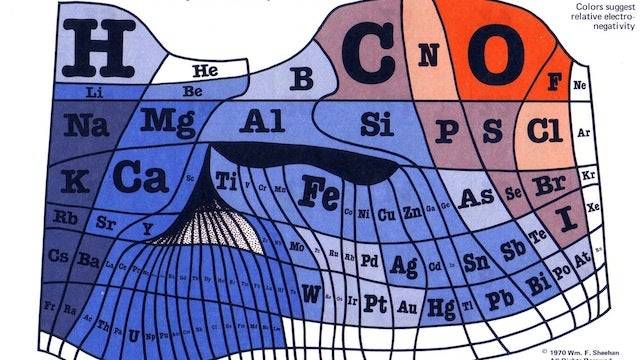
Periodic table according to relative abundance (from io9)
The story surrounding Midas and his golden touch was also examined (Chapter 13- Elements as Money). It seems that Midas' golden touch may have been more of a brass touch. The king's metallurgists thought they were making bronze, an alloy of tin and copper, but in fact were making brass, an alloy of copper and zinc. Thus, the brass had more of a golden tone to it. Indeed, the soil in the area of Asia where Midas once ruled is indeed rich in zinc and present day metallurgists have shown this hypothesis to be a likely explanation for the myth. 

The book explores other topics including how elements are used in times of war. In Chapter 5, Kean talks about the importance of molybdenum (wolfram, W) in the development of Germany's weapons, which were spiked with wolfram to withstand higher heat, in World War I. This chapter also tells the story of Fritz Haber (another great Radiolab episode) as well as the elements that have fueled the conflict in Congo -- tantalum and niobium, which are commonly used in cell phones and other electronics. 

In the end, The Disappearing Spoon, much like Walter White in Breaking Bad, has renewed my appreciation for the periodic table and  helped me understand better some of the things I probably learned 20 years ago. 


A few related links:


For your viewing/listening pleasure, I present They Might be Giants, Meet the Elements.

The dynamic periodic table. I wish they had this kind of thing when I was in school.