 I just discovered the website for the new movie The Fly Room. I could not be more excited to see this film as it combines two of my favorite things: science and cinema. The film is set in Thomas Hunt Morgan's genetics lab at Columbia University. From 1911-1928, Morgan's lab, nicknamed the Fly Room, pioneered the use of fruit flies as a model organism to understand genetics. The lab made several major contributions towards understanding mutations, heredity, and sex-linked traits. Morgan's Fly Room has a unique combination that make it a great subject for a film: an unusual lab space, memorable scientists, and cutting-edge science. (Sam Kean's The Violinist's Thumb does an excellent job of telling this fascinating story in a way that highlights all of these features.)
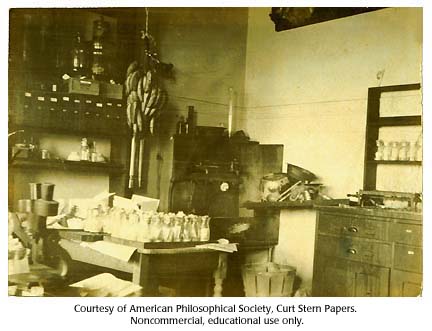
 The lab space has been described as being not much bigger than a broom closet. Archival photos, such as the one above, show benches covered with old milk bottles filled with fruit flies and stuffed with gauze. The lab used bananas to feed the flies, which caused a characteristic fetid odor. It seemed like fruit flies were everywhere, an impression made worse by the small space. Of course, Morgan's habit of squishing non-mutant fruit flies on any available space helped contribute to the mess. The Space Revisited section of the website includes some great movies and details about the process of recreating the unique space for the movie.
The Fly Room at Columbia University - Restored to Its Original State from Imaginal Disc on Vimeo.

The lab also hosted an amazing array of characters. One of these scientists was Calvin Bridges, a handsome genius with an appetite for both science and women. Calvin Bridges was a brilliant scientist, but his philandering damaged his career (Morgan disapproved of his behavior and would not promote him) and cut short his life (Calvin died of syphilis at age 41). After his death, his lab mates burned his personal diaries to protect his reputation.
Alexis Gambis, the film's writer and director, became fascinated with the story of the Fly Room during his PhD in molecular biology at the Rockefeller University. Based on his interest in the story of Calvin Bridges, Gambis sought out Betsey Bridges, the late scientist's daughter. Exchanging stories with Betsey gave Gambis a new way to tell the story of the Morgan lab. The film uses Betsey's visit to the Fly Room as a young girl to explore the girl's relationship with her father as well as the science at the heart of the Morgan lab.
As evidenced by the recent films The Imitation Game and The Theory of Everything, casting scientists as characters in the story of science can create a useful narrative tool. While the focus of these films has been entertainment (indeed, all of these films have taken some degree of poetic license), they also serve as a tool to elucidate the scientific process and inform the public about the importance of basic research. The critical reception of The Fly Room has been very good. I am confident it will show in Boston soon, so I will be sure to update this post when I get to see the film.

More information:
Here is a great story on The Week: Exploring The Fly Room
You can follow The Fly Room on Twitter to see where it is showing next.
Sources:
Sam Kean's The Violinist's Thumb
Cold Spring Harbor Laboratory library: Morgan's lab