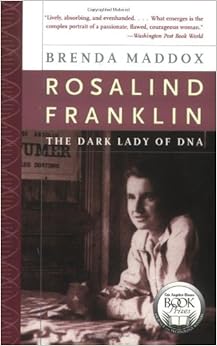
 As a woman in science, I have always admired Rosalind Franklin. Hers is such an archetypal story, one that fits well with the image of women in science being undervalued and underrepresented. I decided to read Rosalind Franklin: The Dark Lady of DNA by Brenda Maddox to see how much of what I knew about Franklin was myth and how much was reality.
Franklin, it seems, was a well-balanced woman, interested in fashion and dressing sharply as well as in mountaineering and outdoor pursuits. She was passionate about her work and loved her time in the lab, but found yearly vacations necessary. She had a knack for buying the perfect gift, especially for the young children in her life. Franklin came from an upper class Jewish family; she went to excellent schools and showed an early gift for math and science. After graduate school in Cambridge, she took a position as a researcher in the lab of Jacques Mering in Paris. She used X-ray crystallography to study the structure of coal, a project she chose for its usefulness to the war efforts. The environment in France suited her well. She developed confidence as a scientist; others in the group described her fastidiousness and her "golden hands". Although Franklin loved life in Paris, she returned to England for a position at King's College London. After agreeing to the position, the group head, (Sir) John Randall, informed her that she would be working on the structure of "certain biological fibres...(called) desoxyribose nucleic acid".
The Biophysics Department at King's was one of the first of its kind. The field of biophysics was sparked by the publication of What is Life? by Erwin Schrödinger in 1944. The book led physicists (like Randall at King's College) to decide that studying biology was a worthwhile pursuit. When Rosalind arrived at King's in 1951, it was a well-established department with a good number of female faculty. Despite this diversity, women were not allowed in the King's senior common room. From the moment she arrived, Rosalind did not feel comfortable. While normally affable and approachable, King's staff members described her as dark, moody, and awkward in conversation. Maddox suggests that class and religion (rather than gender, as suggested by other biographers of Franklin) were the root of the trouble for Franklin at King's. No matter the cause, the tension was not imagined or exaggerated, as evidence by the minor celebration at King's after Franklin's departure.
For Franklin, the conflict was highest with Maurice Wilkins; Maddox makes several suggestions as to what may have kept them from a successful collaboration. Without this icy relationship, Wilkins would surely have conferred with Franklin prior to sharing her data with Watson and Crick. While the book suggests that Wilkins' position as assistant head of the department gave him every right to the data, Wilkins should have spoken with Franklin before sharing her unpublished results as a matter of scientific courtesy.
Rosalind Franklin had a tense relationship with James Watson as well. Watson has become notorious for his traditional view of women (as well as his outdated views of race). For example, upon first meeting Wilkins, Watson noticed that Wilkins took a liking to his sister. Watson considered using his sister as a lure to secure his place in the work on DNA. Watson repeatedly called Franklin "Rosy", a habit that irritated Rosalind, who would only allow close family and friends to call her "Ros". Watson was genuinely afraid that Franklin might strike him due to her "hot anger" after he barged into her office without knocking. Rosalind's anger at this unwelcome entrance may have been an attempt to protect her territory. The week prior, Franklin had complained to a friend that the notebooks in her office had been read without her approval.
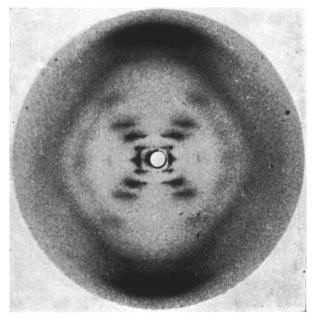 |
| Franklin's photograph 51 |
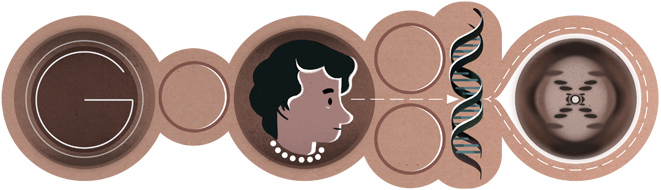 |
| Google doodle celebrating Franklin's 93rd birthday |
Franklin died of ovarian cancer in 1958 at the age of 37. Many have speculated that her work with X-ray radiation led to her cancer. Franklin's early passing highlights the link between scientific discovery and personal sacrifice, which is also a theme for other famous women in science, like Marie Curie (whose story is beautifully told in Radioactive) and Marguerite Perey, who discovered Francium (this long read by her great niece tells her fascinating story). Interestingly, Maddox suggests that Franklin's early onset of cancer may have been due to a mutation in the BRCA gene, a mutation that is more prevalent among Ashkenazi Jews like Franklin. (I have previously explored the population genetics of BRCA gene mutations in my review of The Wandering Gene and The Indian Princess.)
Maddox's book does not make any judgement about Rosalind Franklin's legacy. Interestingly, her 2003 article in Nature suggests that much of what popular culture has taught us about Rosalind Franklin is inaccurate and is biased by the lens of feminism. There, she calls Franklin "the Sylvia Plath of molecular biology." Franklin's sister, Jennifer Glynn, has written several insightful essays about her sister's legacy. In "Remembering my sister Rosalind Franklin", she discusses Watson's portrayal of Franklin as an"obstructive belligerent bluestocking, churning out results secretively and without understanding " in the 1968 book The Double Helix. In 1975, Rosalind's friend Anne Sayre published Rosalind Franklin and DNA to serve as a counterpoint to Watson's book. Both Maddox and Glynn suggest that this book served to swing the pendulum to the extreme of the "wronged heroine" who was robbed of the Nobel Prize.
Franklin's legacy should be neither of these extremes. It is clear that life in science was difficult for women, who were "judged and criticized much more harshly than a man and got less acknowledgment for work well done. (Maddox, p. 288)" Franklin's training was also biased due to her gender; in fact, she had all the major elements of the structure of DNA before Watson and Crick even started to build their model. Because she was trained to be so thorough and was warned against daring, she was hesitant to publish her work until she was absolutely sure of the conclusions. Franklin's interactions with Wilkins, Watson, and Crick were affected by her gender, which closed doors of collaboration for her. In balance, it seems that Franklin would not likely have been nominated for the Nobel with Watson and Crick. However, had she lived, she may have received a Nobel for her work with tobacco mosaic virus; Aaron Klug (her trainee and beneficiary after she died) won in 1982 for work that he started with Franklin. Thus, while Rosalind Franklin's legacy as a wronged heroine may be in question, there is no doubt that she was a superb scientist and an immensely interesting person.
 |
| Photo credit Ben Hammersly via Twitter (@benhammersley) |