Showing posts with label BRCA mutations. Show all posts

Friday, July 31, 2015

Pandora's DNA: One woman's experience with a BRCA mutation

In Pandora's DNA: Tracing the Breast Cancer Gene through History, Science, and One Family Tree, Lizzie Stark describes her experience with a BRCA mutation, which has left its mark on generation after generation of women in her family. Like The Cancer Chronicles, Stark explores the science to understand the causes and consequences of the BRCA mutation. As a child, Stark watched her young mother as well as many of the women in her family endure breast and ovarian cancer and the subsequent treatments. In the nineties, when the BRCA gene test was first available, Stark accompanied her mother to appointments with a genetic counselor, who informed them that her family has a mutation in the BRCA1 gene called 3600del11 (a truncation mutation where 10 DNA bases are deleted from exon 11), a mutation that seems to be more prevalent in French families (for more on the population genetics of BRCA mutations, check out The Wandering Gene and the Indian Princess).

Upon learning of her mother's BRCA status, Stark realizes that she has a 50% chance of having the same mutation. Thus, she decides to learn more about the history of breast and ovarian cancer diagnosis and treatment to inform her decisions about her own treatment options. The radical mastectomy was introduced by the unusual and innovative surgeon William Halsted. Halsted (the basis for the drug-addicted surgeon on The Knick) started his career in 1880; he developed the first blood transfusion, pioneered the use of rubber gloves (through a partnership with the Goodyear rubber company) for surgery, and performed the first mastectomy in the US. Because patients regularly relapsed after this treatment, Halsted decided that a more extensive mastectomy was the solution to the problem; the radical mastectomy was designed to carve out the root of the cancer. However, the procedure, which takes both the breasts and the pectoral muscles, still has a recurrence rate of 60%. Despite these grim statistics and the fact that the procedure negatively affected women's posture and arm mobility, the radical mastectomy was the standard for care for breast cancer for nearly a hundred years.

A med student named Emil Grubbe experimented with the use of radiation to treat cancer recurrence following mastectomy; Grubbe reasoned that radiation might kill rapidly dividing cells like those in cancer. His treatment worked well for many patients, but cost the doctor his own life to radiation-induced cancer. Dr. Geoffrey Keynes (brother to the economist John Maynard Keynes) became a strong proponent the lumpectomy, a more conservative surgery that removes only the tumor and a bit of surrounding tissue, in combination with radiation therapy. In 1935, Keynes started comparing survival rates for patients receiving the combined treatment with those who had a radical mastectomy. Surprisingly, survival rates were nearly identical. Despite the fact that this less aggressive treatment was just as effective, the medical community ignored the results. It wasn't until a study published in 1981 confirmed these results that the Halsted method was finally called into question. In fact, until the 1970's, if a woman had a suspicious lump in her breast, she would be taken in for exploratory surgery, where the surgeons would biopsy the tumor and, if necessary, remove the breast without waking her up. Thus, women would go into surgery and not know whether they would wake up "with a band-aid or without breasts". This practice added psychological difficulty to the radical mastectomy. However, the women's health movement of the 1970's helped give women more power in this process and improve the life of women after treatment.

Location of the BRCA1 gene (Wikipedia)
One hero of the story is Mary-Claire King, who identified the BRCA1 gene's connection to inherited breast and ovarian cancers. (King has led an extraordinary life. In addition to her role in the BRCA story, her lab helped UN war crimes tribunals identify victims when DNA testing was still in its infancy. She tells a great story at The Moth about the connection between BRCA and Joe DiMaggio.**) After King announced her findings, a competing group formed Myriad Genetics, a company that would later patent the BRCA1 and BRCA2 genes, which allowed the company to set the price for the mutation screening. A 2013 Supreme Court decision eliminated this patent, which lowered the price for the test. Myriad Genetics has become the big bad in the BRCA story. Stark's interview with a patent attorney points out that by monetizing the BRCA test, the company was able to make it more widely available. This interview also includes an interesting discussion of the pros and cons of patenting a gene. Despite the patent ruling, Myriad Genetics has refused to share all of the data obtained from their BRCA testing, which could impede research on identifying additional BRCA mutations linked to cancer.

Stark is in the first cohort of women (along with Angelina Jolie) who are able to choose to test for the BRCA mutation. When Stark learns of her BRCA status, she then considers her treatment options: constant cancer screenings or preventative mastectomy and oopherectomy. Here, the author discusses her thought process as well as the published research as she comes to terms with her BRCA status and the health decisions she must make. Stark does an excellent job describing the research, especially considering she is not trained in science. Overall, I found the book both readable and informative; thus, it will be a useful read for a person whose family is affected by a BRCA mutation.

-------------------------------------------------------------------------------------------------------------------------
** For more on the story of Mary-Claire King and her research in hereditary breast and ovarian cancer, check out the film Decoding Annie Parker

Thursday, July 16, 2015

The Emperor of All Maladies - part three of Ken Burns' PBS documentary

In all my reading about cancer biology, I have yet to tackle The Emperor of All Maladies, which is said to be the best book on the subject. Luckily, PBS and Ken Burns have delivered a three-part series based on Siddhartha Mukherjee's 2011 book. Here, I will do a short synopsis of Part Three, "Finding the Achilles Heel", which focuses on the development of cancer therapies.

The documentary begins with the story of Gleevec (covered beautifully in Jessica Wapner's The Philadelphia Chromosome), which was designed specifically to treat a type of chronic myelogenous leukemia (CML) that is caused by a swapping of two chromosomes to create the Philadelphia chromosome. The success of Gleevec led to great hope  could this be the first of many targeted therapeutics? Indeed, there have been some successes in targeted therapies; ALK inhibitors have shown some promise for the treatment of cancers that are characterized by the presence of an ALK gene rearrangement. However, on average, only four targeted therapy drugs are approved per year. These drugs are typically very expensive and are not very successful in terms of extending patients' lives.

The complexity of cancer has been a major obstacle in the development of successful therapeutics. When the human genome was completed in 2001, a new hypothesis arose: if we sequence common cancers and compare with normal cells, we could begin to understand exactly how they differ. In 2005, The Cancer Genome Atlas (TCGA) project began; this large-scale sequencing project aims to identify mutations in 25 different types of commonly occurring cancers. The first results, released in September 2008, confirmed cancer's complexity. Many cancers had multiple mutations in as many as 100 genes. However, there were some cancers that had only a few mutations or showed recurrent mutations, which were found in many different patients. These less complex cancers are the focus of future directions. As more and more cancer genomes are completed, researchers can start to identify patterns in the mutations that appear in cancers; such analyses may lead to the identification of driver mutations (i.e., mutations that are causally linked to oncogenesis) versus passenger mutations (i.e., mutations that are picked up along the way). Mukherjee points out how much drug companies have benefited from the information from basic research. He suggests that the current funding environment, where increased funding of clinical and translational studies comes at the expense of basic research, is not likely to promote these types of success stories in the future.

ACS, anti-smoking ad 1968
The shift in focus from cancer treatment to cancer prevention has generally been a useful approach. For example, smoking was once a major contributor to cancer, but anti-smoking campaigns starting in the late 1960's have successfully reduced the number of new lung cancer cases. Obesity is another major contributor, but solving this health problem has been less straightforward. Viruses like human papilloma virus (HPV) and hepatitis are also common causes for cancers; these viruses are now decreasing in incidence with vaccines for both viruses available. Approximately 40% of cancers are due to unknown causes. Epidemiology focuses on determining a causal link between cancers and environmental factors (e.g., pollution, occupation, cell phones), but the connections are often difficult to prove (as was discussed in Toms River.) Overall, the combination of prevention, early detection, and targeted therapies has decreased the cancer mortality rate 20% in the US over the last two decades.


For me, the most interesting part of the this episode was about cancer immunotherapy. Cellular immunotherapy takes immune cells from a patient's blood, activates these cells, and then gives them back to the patient; this approach boosts the immune system by enriching for T cells. Some researchers have suggested that the immune system is held back from attacking cancer because it is the patient's own cells. In 1992, the FDA approved a therapy using interleukin-2 (IL-2), a protein produced by white blood cells during the immune response. Increasing IL-2 leads to increased T cell response, making T cells more likely to recognize and attack cancer cells. After that initial success, there were few breakthroughs, but some recent developments have increased interest in the field. For example, in 2011 the FDA approved Yervoy (ipilimumab), which binds and blocks CTLA-4, a checkpoint protein that prevents T-cell activation to keep cells from attacking healthy tissue. Thus, when CTLA-4 is blocked, T cells can attack tumors. Both Yervoy and IL-2 treatment show long-lasting responses, but only in a small percentage of patients; serious side effects are also common. The newest weapon in the immunotherapy arsenal is an inhibitor of PD-1, called Opdivo (nivolumab). PD-1 is another checkpoint protein, which some cancers use to disable the T cells in the area surrounding the tumor. PD-1's specificity to cancer cells suggests that Opdivo could be more powerful and less toxic than existing therapies. Based on these exciting developments, this is likely an area to watch in the coming years. 

--------------------------------------------
** You can read more about cancer immunotherapy in this feature in Nature, this Nature review by Ira Mellman, or the April 2015 special issue of Cancer Cell focused on immunotherapy in cancer.

Sunday, December 1, 2013

The Wandering Gene: BRCA1 mutations and population genetics

For some time I have been searching for a book similar to Rebecca Skloot's book about Henrietta Lacks. After some searching on Amazon, I found The Wandering Gene and the Indian Princess: Race, Religion, and DNA, which a number of review suggested was just as good. Because it was on the shelves of my local library, I picked it up immediately. Jeff Wheelwright's book examines the population genetics of a particular BRCA1 mutation. The BRCA1 and BRCA2 (breast cancer 1 and 2) genes were first linked to heritable breast and ovarian cancer (HBOC) in the early nineties. Since the initial discovery of the genes, scientists have identified many mutations in BRCA1 and 2 that are linked with HBOC as well as other cancers.

When functioning properly, the BRCA tumor suppressor genes produce proteins (breast cancer type 1/2 susceptibility protein) that are primarily involved in DNA repair. These proteins ensure that cells with errors in their DNA sequence either fix the mistakes or are destroyed. When a BRCA mutation is present, there is still a wild type ("normal") copy of the BRCA gene on the matching chromosome. Thus, the presence of a BRCA mutation is not necessarily an assurance of getting cancer (cancer risk rates for BRCA mutation carriers range from 35-80%, depending on the study and the type of cancer). If something occurs to alter the function of the wild type copy of the gene, then the cell is left with no functional BRCA1 or 2. Thus, DNA errors become more prevalent, which makes it more likely that a healthy cell will become a cancer cell. BRCA mutations account for only 10% of breast cancers; the majority of cancers are sporadic, caused by random rather than inherited mutations.  

The Wandering Gene focuses on the BRCA1 185delAG mutation; this mutation is due to the deletion (del) of two DNA residues (A and G, or adenine and guanine) at position 185, which results in a frame shift (or misreading) in the DNA sequence and ultimately the sequence of the protein that the DNA encodes**. This particular BRCA1 mutation has been linked to Ashkenazi or Eastern European Jews. Here, the author meets the Medinas, an Hispano family from New Mexico, as they receive genetic counseling and testing for the 185delAG mutation. The family is descendants of Native Americans and Spanish Catholics; thus, they were surprised to learn that they carry a mutation that has been linked to Ashkenazim. Geneticists and historians think that the 185delAG mutation in this group likely arose from a population of Jews from Spain, who were persecuted during the inquisition, converted to Catholicism, and then established themselves in the Americas.


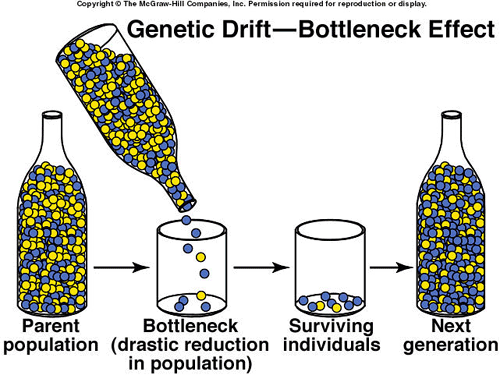
The most interesting element of the book examines where the 185delAG mutation arose and how it became fixed in one particular population. There is evidence that a 2500-year-old Jewish founder could be the source of the mutation. Two particular characteristics of Jewish history (the cultural isolation and the large losses of population, such as from pogroms, forced relocation, and mass murders) led to frequent genetic bottlenecks. Bottlenecks occur due to the loss of genetic variability in a population; dramatic losses of population size can cause deleterious mutations (such as the BRCA1 mutation) to become fixed in a group. The founder effect can also explain the presence of other heritable diseases that are linked to the Jewish population, such as Tay-Sachs disease (carried by one in 25 Ashkenazim) and more than forty other genetic disorders.  It is important to note here that Jews are not more susceptible to genetic mutations; it is simply that, for a variety of reasons, they have been studied more thoroughly than other population groups. There are other examples of founder effects in small, isolated populations, including the Amish and fundamentalist Mormons.

The book also discusses the rise in genetic screening in certain populations where BRCA mutations are more common. Interestingly, such large-scale screening programs began in an effort to control Tay-Sachs disease as early as the 1980s. A group called Dor Yeshorim  screens Orthodox Jews for the most common genetic disorders and informs couples looking to wed whether or not they are a good genetic match. This approach has decreased the incidence of Tay-Sachs disease. The blood samples from Dor Yeshorim were useful for determining the prevalence of the 185delAG mutation in the Jewish population (1%). A recent story in the New York Times highlights the efforts in Israel, where one in 40 women carry a mutation in BRCA (compared to one in 100 women in the population as a whole), to begin universal screening for the mutations. The June 2013 Supreme Court decision, which ruled that naturally occurring human genes and mutations cannot be patented, should decrease the cost of the test in the United States. Prior to that decision, Myriad Genetics held patents on BRCA1 and 2, which led to high costs (more than $3000) for the test.

The subtitle of the book is definitely a good representation of what is inside; each of these topics seemed to get equal treatment. When the focus was on the DNA or race, the book held my interest. However, when the focus was more on religion, I found myself skipping pages. I didn't see how the history and beliefs of the Jehovah's witnesses helped the reader understand the genetics of this mutation. There were some surface similarities with Rebecca Skloot's book, as both have a very strong human angle. The book was a quick read, it taught me some new things about population genetics and BRCA mutations, and it served as an excellent jumping-off point for me to learn more.


**Footnote: If you imagine DNA as a sequence of three letter words, the phrase "The fat cat has the hat" becomes a very different sentence if two letters (at of cat) are eliminated and the spacing stays the same: "The fat cha sth eha t".