Showing posts with label Cancer Chronicles. Show all posts

Friday, July 31, 2015

Pandora's DNA: One woman's experience with a BRCA mutation

In Pandora's DNA: Tracing the Breast Cancer Gene through History, Science, and One Family Tree, Lizzie Stark describes her experience with a BRCA mutation, which has left its mark on generation after generation of women in her family. Like The Cancer Chronicles, Stark explores the science to understand the causes and consequences of the BRCA mutation. As a child, Stark watched her young mother as well as many of the women in her family endure breast and ovarian cancer and the subsequent treatments. In the nineties, when the BRCA gene test was first available, Stark accompanied her mother to appointments with a genetic counselor, who informed them that her family has a mutation in the BRCA1 gene called 3600del11 (a truncation mutation where 10 DNA bases are deleted from exon 11), a mutation that seems to be more prevalent in French families (for more on the population genetics of BRCA mutations, check out The Wandering Gene and the Indian Princess).

Upon learning of her mother's BRCA status, Stark realizes that she has a 50% chance of having the same mutation. Thus, she decides to learn more about the history of breast and ovarian cancer diagnosis and treatment to inform her decisions about her own treatment options. The radical mastectomy was introduced by the unusual and innovative surgeon William Halsted. Halsted (the basis for the drug-addicted surgeon on The Knick) started his career in 1880; he developed the first blood transfusion, pioneered the use of rubber gloves (through a partnership with the Goodyear rubber company) for surgery, and performed the first mastectomy in the US. Because patients regularly relapsed after this treatment, Halsted decided that a more extensive mastectomy was the solution to the problem; the radical mastectomy was designed to carve out the root of the cancer. However, the procedure, which takes both the breasts and the pectoral muscles, still has a recurrence rate of 60%. Despite these grim statistics and the fact that the procedure negatively affected women's posture and arm mobility, the radical mastectomy was the standard for care for breast cancer for nearly a hundred years.

A med student named Emil Grubbe experimented with the use of radiation to treat cancer recurrence following mastectomy; Grubbe reasoned that radiation might kill rapidly dividing cells like those in cancer. His treatment worked well for many patients, but cost the doctor his own life to radiation-induced cancer. Dr. Geoffrey Keynes (brother to the economist John Maynard Keynes) became a strong proponent the lumpectomy, a more conservative surgery that removes only the tumor and a bit of surrounding tissue, in combination with radiation therapy. In 1935, Keynes started comparing survival rates for patients receiving the combined treatment with those who had a radical mastectomy. Surprisingly, survival rates were nearly identical. Despite the fact that this less aggressive treatment was just as effective, the medical community ignored the results. It wasn't until a study published in 1981 confirmed these results that the Halsted method was finally called into question. In fact, until the 1970's, if a woman had a suspicious lump in her breast, she would be taken in for exploratory surgery, where the surgeons would biopsy the tumor and, if necessary, remove the breast without waking her up. Thus, women would go into surgery and not know whether they would wake up "with a band-aid or without breasts". This practice added psychological difficulty to the radical mastectomy. However, the women's health movement of the 1970's helped give women more power in this process and improve the life of women after treatment.

Location of the BRCA1 gene (Wikipedia)
One hero of the story is Mary-Claire King, who identified the BRCA1 gene's connection to inherited breast and ovarian cancers. (King has led an extraordinary life. In addition to her role in the BRCA story, her lab helped UN war crimes tribunals identify victims when DNA testing was still in its infancy. She tells a great story at The Moth about the connection between BRCA and Joe DiMaggio.**) After King announced her findings, a competing group formed Myriad Genetics, a company that would later patent the BRCA1 and BRCA2 genes, which allowed the company to set the price for the mutation screening. A 2013 Supreme Court decision eliminated this patent, which lowered the price for the test. Myriad Genetics has become the big bad in the BRCA story. Stark's interview with a patent attorney points out that by monetizing the BRCA test, the company was able to make it more widely available. This interview also includes an interesting discussion of the pros and cons of patenting a gene. Despite the patent ruling, Myriad Genetics has refused to share all of the data obtained from their BRCA testing, which could impede research on identifying additional BRCA mutations linked to cancer.

Stark is in the first cohort of women (along with Angelina Jolie) who are able to choose to test for the BRCA mutation. When Stark learns of her BRCA status, she then considers her treatment options: constant cancer screenings or preventative mastectomy and oopherectomy. Here, the author discusses her thought process as well as the published research as she comes to terms with her BRCA status and the health decisions she must make. Stark does an excellent job describing the research, especially considering she is not trained in science. Overall, I found the book both readable and informative; thus, it will be a useful read for a person whose family is affected by a BRCA mutation.

-------------------------------------------------------------------------------------------------------------------------
** For more on the story of Mary-Claire King and her research in hereditary breast and ovarian cancer, check out the film Decoding Annie Parker

Friday, December 19, 2014

What ever happened to Brontosaurus?

I have only recently realized that Brontosaurus is no longer a dinosaur. All of my son's books about dinosaurs had the longed-necked sauropod labeled as Apatosaurus, suggesting that something is very different from when I was a kid. Luckily, Brian Switek's book My Beloved Brontosaurus: on the road with old bones, new science, and our favorite dinosaurs explains what happened. Briefly: in 1877, Yale paleontologist O.C. Marsh discovered a partial skeleton of a young dinosaur that he named Apatosaurus; two years later when he found a similar skeleton, he called it Brontosaurus. In 1903, another paleontologist (Elmer Riggs) argued that the differences between the two skeletons were not great enough to warrant two different species. Because Apatosaurus was named first, it had priority for the scientific name. For some unknown reason, this development did not filter down to popular culture or even museums. According to Switek, the changes weren't made until the late eighties. Even after that, it was hard for people to adapt to the change. Switek compares the sadness we experienced at the loss of Brontosaurus with the news that Pluto was no longer a planet.

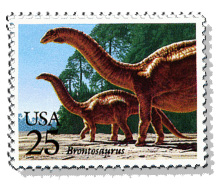
Brontosaurus stamp from 1989
Switek, a lifelong dinosaur freak, uses what he learned about dinosaurs as a child to illustrate how much our understanding of dinosaurs has changed. In the case of dinosaurs like Apatosaurus, everything we were taught was incorrect: they are no longer considered to be slow creatures, dragging their tails through a semi-aquatic environment. Another major change in our picture of dinosaurs is that they were not scaly like alligators; scientists now think that most, if not all, dinosaurs had feathers. As the connection between dinosaurs and birds is strengthened, scientists have started to consider that the prehistoric creatures may have even been brightly colored like birds. This is another case where the general public is likely to have a tough time adapting its image of Tyrannosaurus rex as a furry rather than a scaly lizard.

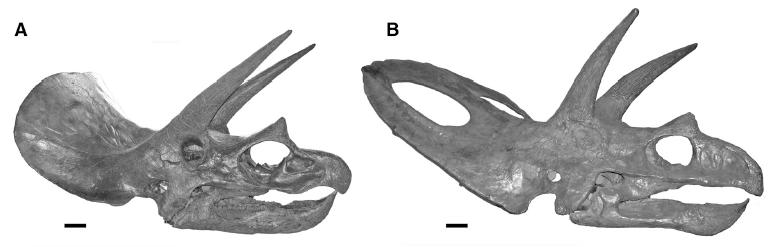
Young adult (left) and adult Triceratops skull
Switek also highlights some of the major unanswered questions about dinosaurs, including what sort of developmental changes dinosaurs went through. Interestingly, the well-known Triceratops shows how much dinosaurs may change in their lifetime. The skull on the left is consistent with what we think of as a Triceratops. The skull on the right is also a Triceratops (although for a while it was called a Torosaurus); the difference may simply be age. (Switek digs further into this story for Smithsonian.) Of course, the big question still is: what caused the extinction of the dinosaurs? The author treats this question fairly, discussing where scientists are landing on this issue (most agree that a very large meteor was to blame). Along the way, he also discusses how dinosaurs were not immune to the "slings and arrows of life". Many fossilized dinosaur remains have been diagnosed with pathogens of varying sorts, as well as cancer (as I learned in reading The Cancer Chronicles).

It is a great time to be a dinosaur lover. There have been some really amazing dinosaur finds in the past few years. For instance, for more than fifty years, the 8-foot-long set of arms shown on the right spurred the curiosity of many dinosaur fanatics; in October, researchers published their discovery of a full Deinocheirus skeleton, which was almost as weird as you might have imagined looking at those crazy arms (coverage by Ed Yong). The gigantic sauropod (and not so close relative of the Brontosaurus) called Dreadnaughtus was found in southern Argentina also made headlines due to its great size. Amazingly, this is not the end of the size spectrum for sauropods; size was clearly a huge advantage for these beasts.

The stories of these amazing creatures that dominated the Earth for millions of years are fascinating. Switek's book has inspired me to visit some of the great museums and dig sites in the states.

Saturday, October 25, 2014

The Cancer Chronicles - George Johnson's personal exploration of cancer, its origins, and treatments

I have recently reviewed books about the discovery and treatment (The Philadelphia Chromosome) and the causes of cancer (Toms River). So the subject matter in George Johnson's The Cancer Chronicles is quite familiar to me. Johnson does have a unique angle – his wife was diagnosed with uterine cancer, which led him to use his expertise as a science writer to learn more about the disease. This perspective helps create a personal element to the book, but does not distract from the science.

Several of the stories were previously covered in other books that I have reviewed: Boveri's prescient hypothesis linking chromosomal aberrations with cancer (The Philadelphia Chromosome), Thomas Hunt Morgan's mutant fruit flies (The Violinist's Thumb), scrotal cancer in chimney sweeps (Toms River), and the Radium girls (The Poisoner's Handbook). Johnson covers new ground in the chapter called "Jurassic Cancer", which examines the other animals in which cancers have been found. In fact, most animals get cancer; the one exception is naked mole rats. Surprisingly, various types of malignancies have even been identified in dinosaur fossils. Another chapter examines how far back in human populations cancers have been described. Johnson writes, "There were signs of cancer in an Iron Age man in Switzerland and a fifth century Visigoth from Spain" (p 49). In both animals and humans, it is difficult to know the exact frequency of the disease, but it is clear that cancer is not strictly linked to industrialization or environmental factors. 

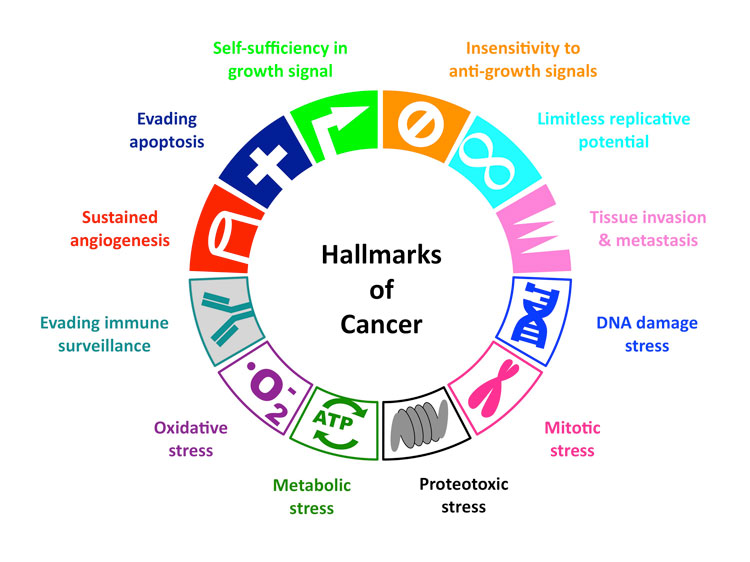
Hanahan and Weinberg, 2000.
Rather, it seems that cancer is inevitable. The landmark review "The Hallmarks of Cancer" (and its update in 2011) states that cancer is basically caused by the accumulation of several mutations. The review's author Robert Weinberg estimates that every second four million cells are replicating in a human body. Each time a cell replicates, there is a chance for error. While there are many error correction mechanisms, mistakes do get through. This genetic variability is the fodder for evolution by natural selection. It is also the source for cancer. Thus, it makes sense that cancer is generally seen throughout the animal kingdom and throughout time. Johnson concludes that it is comforting to know that cancer has always been with us.

Johnson also discusses cancer cell evolution, which is a topic of intense interest in scientific research. Cancer cells are constantly changing to evade the body's defense mechanisms. During treatment, some cancer cells can develop resistance to chemotherapeutics. Understanding how chemoresistant cancers can be treated is a major unanswered question. In the case of Gleevec/imatinib-resistant cancer, a single mutation is responsible for Gleevec-resistance, which allowed the development of a second drug (nilotinib) to kill cells with the imatinib-resistant mutation. Unfortunately, and as is to be expected with a complex disease such as cancer, most chemo-resistant cancers are not as clear cut. 

Overall, the book is quite easy to read and covers many important topics, albeit not at the depth of other, more focused books on the topic of cancer. I will definitely be adding The Emperor of All Maladies to my reading list to give this topic another perspective.


** Post script: Johnson's book was short-listed for the 2014 Royal Society Winton Prize for Science books.