Showing posts with label Philadelphia Chromosome. Show all posts

Monday, September 19, 2016

p53: The gene that cracked the cancer code - a review

I wouldn't think that an entire popular science book could be written about one protein, unless that protein is p53. As of this writing, a PubMed search reveals 82,179 scholarly articles about p53. Thus, p53 The Gene That Cracked the Cancer Code by Sue Armstrong has an abundance of source material. Even with the all that information to cover, the author does an excellent job explaining the relevant research in a clear and concise way, using a chronological structure with the main source being interviews with the scientists that did the original research. Unlike many popular science books, Armstrong relies more on the direct quotes from the primary source, ensuring that she gets everything right.

Briefly, p53 (named because the protein is about 53 kilodaltons on a protein gel–a naming convention that swept through some circles of scientific research, but has since been eclipsed by more colorful naming styles) was discovered in 1979. While David Lane is typically credited first, Arnold Levine, Lloyd Old, and Pierre May also deserve acknowledgement for the discovery. Considered to be a tumor suppressor, p53 has cellular roles in genome stability, DNA repair, apoptosis/cell death, and cell metabolism. This book primarily focuses on p53's role as the "guardian of the genome", a term penned to describe that ability of p53 to keep the cell's DNA free of mutations. This role is the primary connection of p53 to cancer: normally, p53 induces cellular suicide (apoptosis/cell death) in cells with DNA damage. p53 is the most commonly mutated gene in cancer and when p53 is mutated, it loses its ability to protect from DNA damage, which can lead to excessive cell growth, a hallmark of tumorigenesis.

Like so many of the books on cancer that I have covered before, this book hit many of the key topics in the area of cancer research. What is unique about this book is that it leads the reader through the sometimes winding roads of scientific research. This includes an in-depth discussion of the p53 mutation database, which collects all the mutations in p53 that have been linked to a variety of cancers. This database has been a rich source of information for researchers over the years. For example, in 1996 researchers showed that lung cancer cases showed p53 mutations in a particular hotspot on the p53 gene. Interestingly, these same mutations were shown by the Pfeifer lab to be induced by the carcinogenic substance in cigarette smoke, benzopyrene diol epoxide (BPDE). This publication was a major win for the 1998 class action lawsuit against Big Tobacco.

Map of p53 mutations and their frequency.
The p53 database has also helped reveal the link between liver cancer, Hepatitis B, and aflatoxin, a poison produced by a fungus that grows on peanuts and other grains when they are stored without adequate ventilation. Typically, HepB causes liver cancer only after many years. However, in places like Asia and Africa, the risk is compounded by the exposure to aflatoxin, a carcinogen known to cause DNA damage. Aflatoxin can induce a mutation in p53 (at codon 2449), which can essentially turn p53 from a tumor suppressor into an oncogene.

The book delves into several of the most damaging p53 mutations. For example, Li-Frameni syndrome (LFS) is a genetic disordered characterized by the early and frequent acquisition of cancer at "every conceivable site in the body". The disease was first described in the early 1980s, but the connection to p53 was not established until the 1990s. A variety of mutations in p53 have been associated with LFS, but the most common hotspot connected to LFS is involved in p53's ability to bind to DNA.

Perhaps the most interesting story in the book describes the cancer clusters in Brazil. Sue Armstrong contributed the story of "Brazil's Cancer Curse" to Mosaic Science; it is a fascinating story and gives a great sense of her writing style. As discussed in the book Toms River, cancer clusters are typically assumed to be caused by a pollutant. Likewise, the Brazilian doctors wondered if that might be the case. However, the research about LFS was starting to garner attention, leading Brazilian clinicians to suspect p53 was also be responsible in the Brazilian cancer cluster. Indeed, sequencing of the p53 gene in affected individuals reveals a mutation at codon 337 to be the most common. Where the story gets really interesting is when scientists attempt to understand how an uncommon mutation fixed in the population at such high frequency. While the source is still debatable, the p53 mutation is now thought to be the result of a founder effect and bottleneck (as described for BRCA mutations in The Wandering Gene).
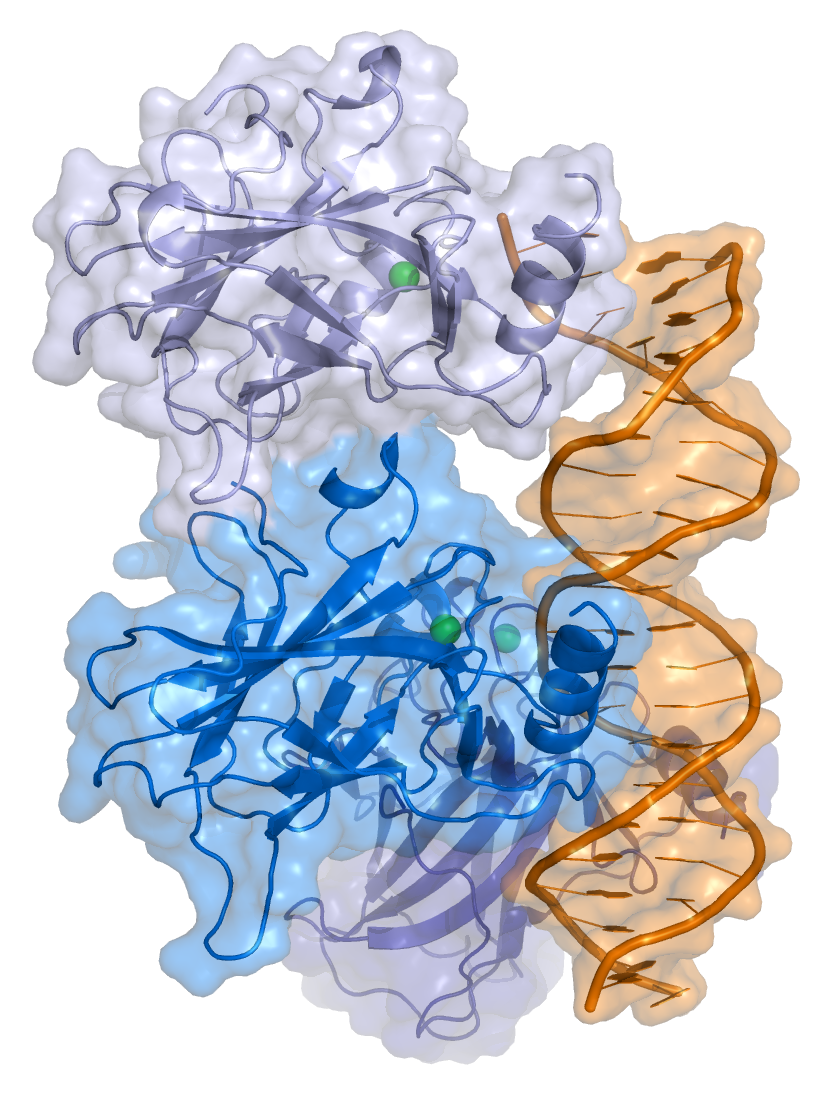
p53 structure (Wikipedia)
I think I learned the most in the section about the clinical approaches to treating p53 mutations. Here, Armstrong has done a deep dive into the literature about the latest drugs and trials connected to p53 function and dysfunction. Thus, the book is up to date on the available p53-related drugs (as of its publication in November 2014). Armstrong describes several different approaches to treating p53-related cancers, including drugs like Advexin, which uses a viral vector to induce cells to express wild type p53. For reasons that are unclear, Advexin has had mixed success in the US and is still awaiting FDA approval. Perhaps more interesting, is the research on PRIMA-1 (an acronym for p53 re-activation and induction of mass apoptosis), a drug designed to work on mutants of p53 that no longer bind DNA. Essentially, PRIMA-1 induces mutant p53 into its wild type shape, allowing it to re-activate and bind DNA. Thus, PRIMA-1 should target a wide range of p53 conformation mutants and leave wild type p53 alone. Both of these have been major roadblocks in the deisng of previous p53 therapies, especially since p53 is at the center of so many regulatory pathways. The drug is currently in Phase 2 trials. (Here, Armstrong takes a tangent into the history of chemotherapy, specifically its connection to the German use of mustard gas in WWII. This was a fascinating story that I recommend reading more about, for example here or here.) 

Sue Armstrong's p53 book distills a large amount of scientific literature into an interesting and readable book. I don't think I would recommend this as the first book to read if you are just starting to learn about cancer research. To me, the best starting place would be The Philadelphia Chromosome (some might recommend Mukherjee's The Emperor of All Maladies). However, this is an excellent book for those familiar with cancer and looking for the next level of science writing on the topic.

Thursday, July 16, 2015

The Emperor of All Maladies - part three of Ken Burns' PBS documentary

In all my reading about cancer biology, I have yet to tackle The Emperor of All Maladies, which is said to be the best book on the subject. Luckily, PBS and Ken Burns have delivered a three-part series based on Siddhartha Mukherjee's 2011 book. Here, I will do a short synopsis of Part Three, "Finding the Achilles Heel", which focuses on the development of cancer therapies.

The documentary begins with the story of Gleevec (covered beautifully in Jessica Wapner's The Philadelphia Chromosome), which was designed specifically to treat a type of chronic myelogenous leukemia (CML) that is caused by a swapping of two chromosomes to create the Philadelphia chromosome. The success of Gleevec led to great hope – could this be the first of many targeted therapeutics? Indeed, there have been some successes in targeted therapies; ALK inhibitors have shown some promise for the treatment of cancers that are characterized by the presence of an ALK gene rearrangement. However, on average, only four targeted therapy drugs are approved per year. These drugs are typically very expensive and are not very successful in terms of extending patients' lives.

The complexity of cancer has been a major obstacle in the development of successful therapeutics. When the human genome was completed in 2001, a new hypothesis arose: if we sequence common cancers and compare with normal cells, we could begin to understand exactly how they differ. In 2005, The Cancer Genome Atlas (TCGA) project began; this large-scale sequencing project aims to identify mutations in 25 different types of commonly occurring cancers. The first results, released in September 2008, confirmed cancer's complexity. Many cancers had multiple mutations in as many as 100 genes. However, there were some cancers that had only a few mutations or showed recurrent mutations, which were found in many different patients. These less complex cancers are the focus of future directions. As more and more cancer genomes are completed, researchers can start to identify patterns in the mutations that appear in cancers; such analyses may lead to the identification of driver mutations (i.e., mutations that are causally linked to oncogenesis) versus passenger mutations (i.e., mutations that are picked up along the way). Mukherjee points out how much drug companies have benefited from the information from basic research. He suggests that the current funding environment, where increased funding of clinical and translational studies comes at the expense of basic research, is not likely to promote these types of success stories in the future.

ACS, anti-smoking ad 1968
The shift in focus from cancer treatment to cancer prevention has generally been a useful approach. For example, smoking was once a major contributor to cancer, but anti-smoking campaigns starting in the late 1960's have successfully reduced the number of new lung cancer cases. Obesity is another major contributor, but solving this health problem has been less straightforward. Viruses like human papilloma virus (HPV) and hepatitis are also common causes for cancers; these viruses are now decreasing in incidence with vaccines for both viruses available. Approximately 40% of cancers are due to unknown causes. Epidemiology focuses on determining a causal link between cancers and environmental factors (e.g., pollution, occupation, cell phones), but the connections are often difficult to prove (as was discussed in Toms River.) Overall, the combination of prevention, early detection, and targeted therapies has decreased the cancer mortality rate 20% in the US over the last two decades.


For me, the most interesting part of the this episode was about cancer immunotherapy. Cellular immunotherapy takes immune cells from a patient's blood, activates these cells, and then gives them back to the patient; this approach boosts the immune system by enriching for T cells. Some researchers have suggested that the immune system is held back from attacking cancer because it is the patient's own cells. In 1992, the FDA approved a therapy using interleukin-2 (IL-2), a protein produced by white blood cells during the immune response. Increasing IL-2 leads to increased T cell response, making T cells more likely to recognize and attack cancer cells. After that initial success, there were few breakthroughs, but some recent developments have increased interest in the field. For example, in 2011 the FDA approved Yervoy (ipilimumab), which binds and blocks CTLA-4, a checkpoint protein that prevents T-cell activation to keep cells from attacking healthy tissue. Thus, when CTLA-4 is blocked, T cells can attack tumors. Both Yervoy and IL-2 treatment show long-lasting responses, but only in a small percentage of patients; serious side effects are also common. The newest weapon in the immunotherapy arsenal is an inhibitor of PD-1, called Opdivo (nivolumab). PD-1 is another checkpoint protein, which some cancers use to disable the T cells in the area surrounding the tumor. PD-1's specificity to cancer cells suggests that Opdivo could be more powerful and less toxic than existing therapies. Based on these exciting developments, this is likely an area to watch in the coming years. 

--------------------------------------------
** You can read more about cancer immunotherapy in this feature in Nature, this Nature review by Ira Mellman, or the April 2015 special issue of Cancer Cell focused on immunotherapy in cancer.

Saturday, October 25, 2014

The Cancer Chronicles - George Johnson's personal exploration of cancer, its origins, and treatments

I have recently reviewed books about the discovery and treatment (The Philadelphia Chromosome) and the causes of cancer (Toms River). So the subject matter in George Johnson's The Cancer Chronicles is quite familiar to me. Johnson does have a unique angle – his wife was diagnosed with uterine cancer, which led him to use his expertise as a science writer to learn more about the disease. This perspective helps create a personal element to the book, but does not distract from the science.

Several of the stories were previously covered in other books that I have reviewed: Boveri's prescient hypothesis linking chromosomal aberrations with cancer (The Philadelphia Chromosome), Thomas Hunt Morgan's mutant fruit flies (The Violinist's Thumb), scrotal cancer in chimney sweeps (Toms River), and the Radium girls (The Poisoner's Handbook). Johnson covers new ground in the chapter called "Jurassic Cancer", which examines the other animals in which cancers have been found. In fact, most animals get cancer; the one exception is naked mole rats. Surprisingly, various types of malignancies have even been identified in dinosaur fossils. Another chapter examines how far back in human populations cancers have been described. Johnson writes, "There were signs of cancer in an Iron Age man in Switzerland and a fifth century Visigoth from Spain" (p 49). In both animals and humans, it is difficult to know the exact frequency of the disease, but it is clear that cancer is not strictly linked to industrialization or environmental factors. 

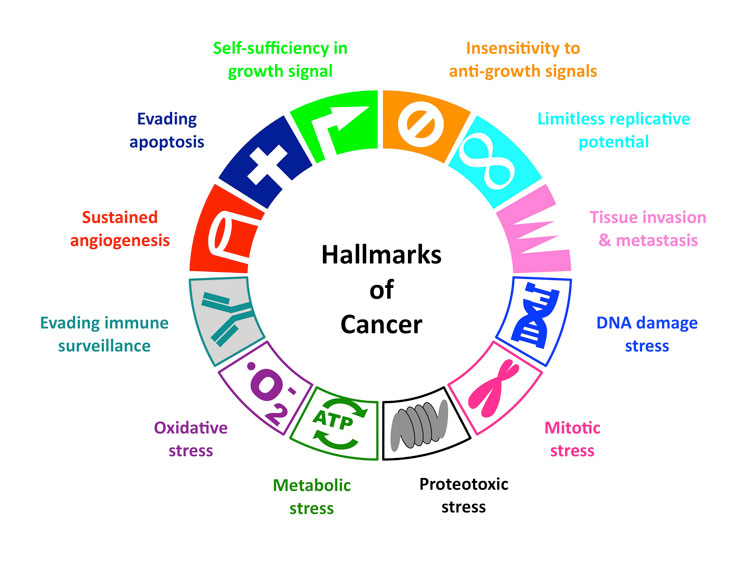
Hanahan and Weinberg, 2000.
Rather, it seems that cancer is inevitable. The landmark review "The Hallmarks of Cancer" (and its update in 2011) states that cancer is basically caused by the accumulation of several mutations. The review's author Robert Weinberg estimates that every second four million cells are replicating in a human body. Each time a cell replicates, there is a chance for error. While there are many error correction mechanisms, mistakes do get through. This genetic variability is the fodder for evolution by natural selection. It is also the source for cancer. Thus, it makes sense that cancer is generally seen throughout the animal kingdom and throughout time. Johnson concludes that it is comforting to know that cancer has always been with us.

Johnson also discusses cancer cell evolution, which is a topic of intense interest in scientific research. Cancer cells are constantly changing to evade the body's defense mechanisms. During treatment, some cancer cells can develop resistance to chemotherapeutics. Understanding how chemoresistant cancers can be treated is a major unanswered question. In the case of Gleevec/imatinib-resistant cancer, a single mutation is responsible for Gleevec-resistance, which allowed the development of a second drug (nilotinib) to kill cells with the imatinib-resistant mutation. Unfortunately, and as is to be expected with a complex disease such as cancer, most chemo-resistant cancers are not as clear cut. 

Overall, the book is quite easy to read and covers many important topics, albeit not at the depth of other, more focused books on the topic of cancer. I will definitely be adding The Emperor of All Maladies to my reading list to give this topic another perspective.


** Post script: Johnson's book was short-listed for the 2014 Royal Society Winton Prize for Science books. 

Wednesday, June 18, 2014

The Philadelphia Chromosome by Jessica Wapner: a story of scientific discovery from the bench to the clinic

The Philadelphia Chromosome by Jessica Wapner focuses on the development of the drug Gleevec for the treatment of leukemia. Wapner really hits the sweet spot of science writing: she explains complex processes completely such that an experienced scientist would be interested and yet simply enough that a layman would also understand. The book's primary source material consists of interviews with scientists. This gives the reader details not found in published articles and makes the book very readable, as the story of scientific discovery becomes about the scientists doing the research. The Philadelphia Chromosome highlights how understanding basic biology can lead to significant advances in the clinic.

Reciprocal translocation of chr. 22with chr. 9. Image by
Peter Lowell
The link between cancer and chromosomal rearrangements had been hypothesized since the work of Theodor Boveri in 1902. However, it was not until the mid-20th century that scientists had the right tools to investigate this connection. By arresting and staining cells during cell division, scientists were able to reliably count chromosomes. (As I learned in The Violinist's Thumb, this was one reason that it took so long to learn how many chromosomes humans actually had.) In the 1950s, Nowell and Hungerford used this staining technique to look for chromosomal rearrangements in patients with chronic myelogenous leukemia (CML). They noticed that chromosome 22 was shorter than it should be, suggesting that part of the chromosome was deleted. The shortened chromosome 22 was termed the Philadelphia chromosome for the city in which it was discovered.

Adapted from Montgomery et al., 2004.
In 1973, Janet Rowley, using an improved technique to stain chromosomes from CML patients, noticed that the missing part of chromosome 22 had migrated to the end of chromosome 9 and vice versa (see image above). Today, chromosomes are frequently imaged using spectral karyotyping (example on right), where each chromosome is fluorescently labeled with a unique color, making the identification of chromosomal abnormalities much simpler. Rowley's work showed that the Philadelphia chromosome was the result of a reciprocal translocation, referred to as t(9:22). In simple terms, if you imagine the genome is like a book with each chromosome being a chapter (yes, I am borrowing from Matt Ridley's book), then the Philadelphia chromosome would result from the switching of pages from the end of Chapter 22 with the later part of Chapter 9. A book with such an error would read very differently than the original version of the book.

The Philadelphia chromosome creates
a Bcr-Abl fusion protein.


The next question: how does the Philadelphia translocation change the DNA sequence on the two effected chromosomes? At the time, this proved to be a challenge because DNA cloning was still in its infancy. In 1978, Heisterkamp and Groffen started to investigate the location of the abl oncogene gene in the human genome. They developed an abl probe, which showed that the gene was on chromosome 9. This result raised the question: was the abl oncogene connected to CML and the Philadelphia chromosome? Amazingly, when the abl probe was used in cells from CML patients with the Philadelphia chromosome (Ph+ CML), the probe could be found both on the Philadelphia chromosome as well as the normal copy of chromosome 9. Next, they had to determine what gene was located next to the abl insertion. Looking at the sequence of chromosome 22 from Ph+ CML patients, they found the "breakpoint cluster region" or bcr next to abl. Thus, the Philadelphia chromosome results in a fusion of the bcr-abl genes (see figure above). Later research from the Baltimore lab demonstrated that introducing a bcr-abl fusion gene in mice could cause CML and CML-like symptoms.

Normally, abl encodes a protein tyrosine kinase. Kinases play an important role in cells: turning on target proteins. To ensure that proteins are activated only as needed, kinase activity must be carefully regulated. The Bcr/Abl fusion protein has unregulated kinase activity, which means that all of the target proteins are activated at higher than normal levels. In the case of CML, this leads to unfettered cell growth and proliferation, particularly in white blood cells. This result suggested that being able to turn off the kinase activity could stop the out of control growth of white blood cells in Ph+ CML patients.

The Bcr-Abl fusion protein (green)
is inhibited by STI-571/imatinib (red)
(from Wikipedia commons).
Around this time, increasing numbers of kinases were being linked to disease, especially cancers, which are typically due to unrestricted cell growth. This coincidence grabbed the attention of chemists at the Swiss pharmaceutical company Ciba-Geigy (now known as Novartis); they hypothesized that kinases could be excellent drug targets. This relatively new approach, called "rational drug design", would target the specific cause of a specific cancer, creating a drone strike as opposed to the "carpet bombing" tactic of most chemotherapeutics (p. 108). For the treatment of CML, scientists would need to design a compound to specifically inhibit the Abl kinase, which many doubted would be possible due to the large number of kinases in the cell. After six years of development, the Ciba-Geigy team identified a compound that selectively and specifically inhibited Abl kinase activity. Eventually, this compound landed in the hands of Brian Druker, who found that the Abl inhibitor (called STI-571 or imatinib) could specifically kill cells derived from Ph+ CML patients as well as from mice engineered to express the Bcr-Abl fusion protein.

Much of this section of the book focuses on the conflict between Druker and Ciba-Geigy, who were hesitant to devote resources to a drug for a relatively rare disease. However, the Orphan Drug Act helped tip the scales in Druker's favor. The approval of STI-571 as an orphan drug ensured that the company would have a fast track for FDA approval as well as a longer term for copyright protection. (Interesting side note: Botox was originally approved as an orphan drug to treat a rare muscle disease. Its later approval as a wrinkle smoother meant that the drug company benefited greatly from that status.) In 2001, after very successful phase I clinical trials, the FDA approved STI-571 under the trade name Gleevec. This caused a paradigm shift in cancer research; the new goal was to find driver mutations for each type of cancer. Today, more than 15 tyrosine kinase inhibitors are available for cancer treatment (e.g, erlotinib for lung cancer and lapatinib for breast cancer). Unfortunately, none of the drugs have been as successful as Gleevec; rather, these drugs give incremental improvements in survival rates. Another confounding factor is that diseases, particularly cancers, are rarely caused by single mutations. However, the advent of large scale genome sequencing projects (as covered in my review of Genome) is improving the chances of connecting diseases with specific mutations.

If I had one complaint about the book, it would be that the focus on Druker's career and personal life, while useful in terms of creating a narrative arc, sometimes distracted from other important elements of the story. The book highlights how basic scientific research is an important starting point for successful clinical outcomes. This lesson is critical to remember when funding for basic scientific research is decreasing and the focus on clinically and translationally relevant research is increasingly important for funding.