Showing posts with label Rosalind Franklin. Show all posts

Wednesday, June 7, 2017

The impact of Nettie Stevens on genetics, chromosome theory, and the naming of cats in our house

We recently welcomed a new member to our family: a beautiful calico cat! We were struggling to find a suitable name for this feisty one. Because I have had so few female cats, I wasn't really sure where to start. As a woman of science, I decided to use female scientists for inspiration.

Then I remembered the work of Nettie Stevens. I stumbled upon Dr. Stevens' work when I was researching Thomas Hunt Morgan for my two posts on the movie The Fly Room. Stevens was most famous for identifying the chromosomal basis of sex inheritance-she found that males are XY and females are XX. Calico cats are almost always female because the genes that control fur color are on the X chromosome, so we decided to name the cat Nettie. What I learned in my reading suggested that Nettie Stevens, like so many female scientists, was pretty amazing and definitely underappreciated for her impact on genetics, chromosome theory, and the use of model organisms in cell biology.

Nettie Stevens (1861-1912) was born in Vermont and grew up in Westford, MA as a fifth generation New Englander and the daughter of a carpenter. Her love of biology was likely spurred by summer science courses on Martha’s Vineyard. She taught high school zoology and physiology for many years, eventually saving up enough to attend Stanford (then Leland Stanford University) at the age of 35. Interestingly, Stanford was about 40% women at the time of Stevens’ matriculation in 1896. According to a Stanford newsletter about Nettie Stevens, they aren't really sure what attracted East Coasters and women in record numbers to their institution at that time. They speculate that it might have been the lower cost of tuition compared with the more established East Coast school.  

Stevens started her doctorate at Bryn Mawr in 1900; at that time the university was home to Thomas Hunt Morgan and Edmund Beecher Wilson, who were both leaders in the burgeoning field of cell biology (then called cytology). Stevens started her PhD in Morgan’s lab at a critical moment in the history of genetics: Gregor Mendel’s work had recently been rediscovered. The big question at that time: what is the biological basis for Mendel’s law of heredity? These ideas were causing excitement in parts of the scientific community. However, Thomas Hunt Morgan was initially not very interested in the Mendel revival. Instead, Morgan focused on the processes of regeneration (admittedly a very cool topic as I have covered in my post on axolotl), which is why Stevens started her PhD studying regeneration in various marine models, including the planaria.

Stevens received a fellowship to fund her travel to Germany to study in the lab of Theodor Boveri. At that time, Boveri was deeply involved in the Mendel revival. Using sea urchins, Boveri had shown that all the chromosomes had to be present for embryonic development to take place. He published these results in 1903 in parallel with Walter Sutton, who showed the same results in grasshoppers during his PhD work in the lab of E.B. Wilson. Wilson later termed this the Boveri-Sutton chromosome theory (notably Sutton, a derelict PhD student, was able to get the recognition that eluded Nettie Stevens.)   

Image courtesy of Rachel Ignotofsky 
Stevens returned from her time in the Boveri lab with a strong interest in the idea of inheritance through chromosomes. Morgan allowed her to work independently on this project, which was uniquely part of the culture in the Morgan lab; as the project progressed, Morgan became interested in the idea as well. For me, this story points out how Stevens was at the leading edge of the Mendel resurgence and brought this interest to the Morgan lab.

In 1903, Stevens completed her PhD at Bryn Mawr, but found it difficult to find a permanent research position. In her application to the Carnegie Institute requesting funding for her research, she stated, “College positions for women in Biology this year seem to be very few.” In her proposal, she planned to study the connection between chromosomes and sex determination, which was controversial at the time. While C. E. McClung had proposed that the “accessory chromosome” could be involved in sex determination, most researchers, including Morgan and Wilson, believed that sex was determined by environmental conditions.


To address this question, Stevens started looking at the full set of chromosomes of many different organisms. In 1905, while observing cell division in the mealworm Tenebrio molitor, she noted that females had 20 large chromosomes, while males had 19 large and 1 small chromosome. She suggested that the sperm determined the sex of the offspring, based on whether it carried the small or the large chromosome. This was in contrast to the results obtained by Wilson, who found that males had one fewer chromosome than females; in his case this was because the organism he studied was XO and XX. In the fall of 1905, Stevens published her work entitled "Studies in Spermatogenesis" just two months after Wilson's work was published. Her conclusions did not gain acceptance, but when Wilson published his next paper confirming the XX/XY inheritance model, the scientific community accepted the results as true. 

Stevens also examined the role of sex chromosomes in a variety of insects and marine organisms, which led her to conclude that the XX/XY inheritance was generalizable. (In contrast, Wilson’s XO males were relatively rare.) Thus, Nettie Stevens was at the vanguard of utilizing different organisms for research in cell biology. In her experimentation with different organisms, she even worked with the fruit fly, Drosophila melanogaster and introduced the model to Morgan's lab.
On July 7, 2016, a Google Doodle celebrated what would have been Dr. Stevens' 155th birthday. This brought her name out of obscurity. Like so many female scientists, perhaps most famously Rosalind Franklin, she had virtually been erased from scientific history. Why did she not get credit for her work? Was it the lack of a permanent position and lab of her own? Or was it a case of sexual discrimination? Some argue that Wilson was given credit not due to primacy of results, but the substance of his entire body of research. While it can't correct this historical oversight, we will acknowledge the contributions of Nettie Stevens in our house.

Further Reading

This post by Cristy Gelling is highly recommended; she details more about the sexism and Morgan's obituary of "Miss Stevens".

This podcast from Babes of Science was fun and filled with facts about Nettie Stevens that I hadn't read elsewhere.

Friday, June 3, 2016

The complex legacy of James Watson

Watson & Crick with their DNA model

James Watson was something of a wunderkind. He started college at age 15 and was only 24 when he published the structure of the DNA double helix with Francis Crick in April 1953. From the beginning, the DNA project was a hotbed of controversy and rivalries. The biggest controversy surrounded Rosalind Franklin and her X-ray crystallography image Photograph 51. Essentially, Watson took Franklin’s data without her permission; the image was the lynch pin in decoding the DNA double helix. This discovery was the basis for his Nobel Prize in medicine in 1962.


Goldblum as Watson in
The Race for the Double Helix
Watson has always been a polarizing figure in molecular biology. He was brash, arrogant, and oftentimes sexist; to give you a sense of his character, he was played adeptly by Jeff Goldblum in The Race for the Double Helix in 1987.  His Wikipedia entry includes a laundry list of controversial comments, which run the gamut of racism, sexism, classism, and homophobia. His comments in 2007 were the final straw for his career; he said "[I am] inherently gloomy about the prospect of Africa [because] all our social policies are based on the fact that their intelligence is the same as ours—whereas all the testing says not really." Those comments caused him to lose many of his academic appointments and speaking engagements. The biggest loss to Watson was his position as chancellor at the Cold Spring Harbor Laboratory (CSHL); he did stay on at the CSHL in an emeritus position.

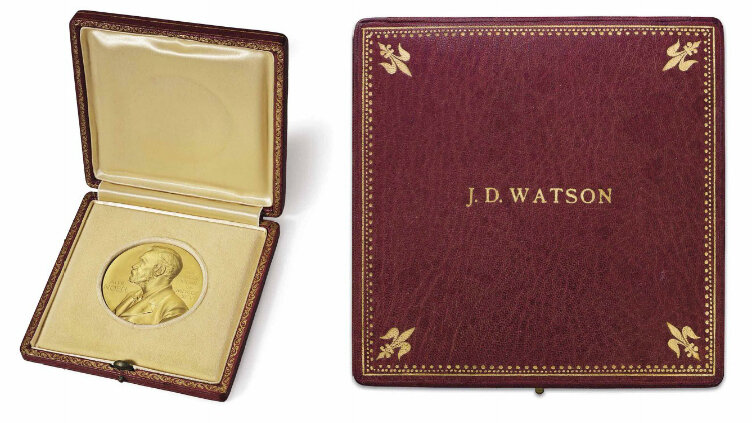
Watson later attempted to distance himself from the comments, saying that he is not racist “in a conventional way”, but the damage was already done. In 2014, Watson made headlines with his decision to auction off his Nobel Prize medal, which was the first time in history the medal from a living Nobel winner would be sold. Watson claimed that his comments made him “an unperson”. He planned to sell the medal to return to public life, donate to the scientific research institutes that made his career, and maybe buy a David Hockney painting. The medal sold for $4.1 M to a Russian billionaire Alisher Usmanov, who later returned the medal to Watson with the caveat that a portion of the money should be donated to science (no mention of the Hockney painting). In the end, while Watson succeeded in getting his cash flow problem resolved, he was unable to erase the damage his controversial comments had done.

Out of curiosity, I decided to investigate the other side of the story. Of course, it was rather difficult to find people who defended Watson and his behavior (I refuse to link to those defenses that are based on the idea that Watson was just another victim of the PC police). One defense I read suggested that Watson's behavior could be explained by his over reliance on science to solve the problems of the world. I find this conclusion unsatisfying. Rather, I prefer the idea, that Watson cultivated an image as a gadfly or a loose cannon, but the quality that he once cultivated became part of his nature.

Honestly, this character has generally been good for his career. If you look at his publication record, it was not nearly as strong as Franklin's or Crick's. And yet, he was chosen as the head of the CSHL and as a figure head for the Human Genome Project. Despite his decries of being "an unperson", he still contributes opinions to various platforms and is called for comment on stories in the New York Times (most recently in this great piece about Otto Warburg, which I frankly felt did not need his contribution). In addition, you can still find the occasional mention of him giving lectures (most recently at Harvard in Feb 2016, where he lectured on how to achieve success). 

The legacy of James Watson shows us how an accomplished scientist can still be an awful person. While most scientists I know still get excited to see the old man shambling about during summer meetings at Cold Spring Harbor, they know it is best to avoid talking to him.

***
This post is based on something I put together for a post on r/redditdayof on the theme of "Watson".

Additional Sources: Opinion from scientist Adam Rutherford in The Guardian; Slate article Watson Throws a Fit

Thursday, February 26, 2015

The complex legacy of Rosalind Franklin

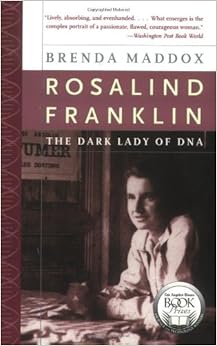
As a woman in science, I have always admired Rosalind Franklin. Hers is such an archetypal story, one that fits well with the image of women in science being undervalued and underrepresented. I decided to read Rosalind Franklin: The Dark Lady of DNA by Brenda Maddox to see how much of what I knew about Franklin was myth and how much was reality.

Franklin, it seems, was a well-balanced woman, interested in fashion and dressing sharply as well as in mountaineering and outdoor pursuits. She was passionate about her work and loved her time in the lab, but found yearly vacations necessary. She had a knack for buying the perfect gift, especially for the young children in her life. Franklin came from an upper class Jewish family; she went to excellent schools and showed an early gift for math and science. After graduate school in Cambridge, she took a position as a researcher in the lab of Jacques Mering in Paris. She used X-ray crystallography to study the structure of coal, a project she chose for its usefulness to the war efforts. The environment in France suited her well. She developed confidence as a scientist; others in the group described her fastidiousness and her "golden hands". Although Franklin loved life in Paris, she returned to England for a position at King's College London. After agreeing to the position, the group head, (Sir) John Randall, informed her that she would be working on the structure of  "certain biological fibres...(called) desoxyribose nucleic acid". 

The Biophysics Department at King's was one of the first of its kind. The field of biophysics was sparked by the publication of What is Life? by Erwin Schrödinger in 1944. The book led physicists (like Randall at King's College) to decide that studying biology was a worthwhile pursuit. When Rosalind arrived at King's in 1951, it was a well-established department with a good number of female faculty. Despite this diversity, women were not allowed in the King's senior common room. From the moment she arrived, Rosalind did not feel comfortable. While normally affable and approachable, King's staff members described her as dark, moody, and awkward in conversation. Maddox suggests that class and religion (rather than gender, as suggested by other biographers of Franklin) were the root of the trouble for Franklin at King's. No matter the cause, the tension was not imagined or exaggerated, as evidence by the minor celebration at King's after Franklin's departure.

For Franklin, the conflict was highest with Maurice Wilkins; Maddox makes several suggestions as to what may have kept them from a successful collaboration. Without this icy relationship, Wilkins would surely have conferred with Franklin prior to sharing her data with Watson and Crick. While the book suggests that Wilkins' position as assistant head of the department gave him every right to the data, Wilkins should have spoken with Franklin before sharing her unpublished results as a matter of scientific courtesy.

Rosalind Franklin had a tense relationship with James Watson as well. Watson has become notorious for his traditional view of women (as well as his outdated views of race). For example, upon first meeting Wilkins, Watson noticed that Wilkins took a liking to his sister. Watson considered using his sister as a lure to secure his place in the work on DNA. Watson repeatedly called Franklin "Rosy", a habit that irritated Rosalind, who would only allow close family and friends to call her "Ros". Watson was genuinely afraid that Franklin might strike him due to her "hot anger" after he barged into her office without knocking. Rosalind's anger at this unwelcome entrance may have been an attempt to protect her territory. The week prior, Franklin had complained to a friend that the notebooks in her office had been read without her approval.

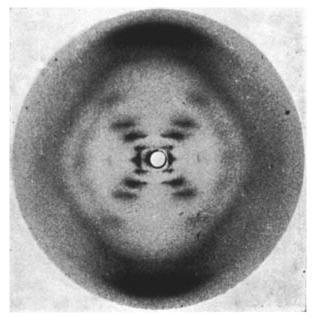
Franklin's photograph 51
In 1953, Franklin was planning a move to Birkbeck College. Before the move, she wanted to finish two papers for publication in Nature: one on the two forms of DNA and one on the helical structure of DNA based on her crystal data (her famous photograph 51). At the same time, Watson and Crick were building a model of the structure of DNA. Franklin found this approach to be premature. In fact, her Nature paper (published as the last of the three of papers in the April 1953 issue) had all the important features of the double helical structure that were present in the Watson and Crick paper. To me, her cautious approach to scientific pursuits was likely due to her training. For women, "science was taught... [as] an intellectual endeavor calling for neatness, thoroughness and repetition, rather than excitement and daring (p 33)." This careful approach was in stark contrast to the tactic taken by Watson and Crick. This cautiousness may have cost Franklin her place in history as much as her difficult relationship with Wilkins.

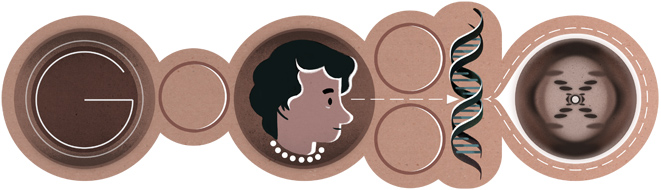
Google doodle celebrating Franklin's 93rd birthday
Interestingly, Franklin's relationship with James Watson improved after the 1953 Nature publications. However, Franklin was never aware of the importance of her data in the work done by Watson and Crick. Only after her death did Watson and Crick clarify how critical her crystal data were for their success.

Franklin died of ovarian cancer in 1958 at the age of 37. Many have speculated that her work with X-ray radiation led to her cancer. Franklin's early passing highlights the link between scientific discovery and personal sacrifice, which is also a theme for other famous women in science, like Marie Curie (whose story is beautifully told in Radioactive) and Marguerite Perey, who discovered Francium (this long read by her great niece tells her fascinating story). Interestingly, Maddox suggests that Franklin's early onset of cancer may have been due to a mutation in the BRCA gene, a mutation that is more prevalent among Ashkenazi Jews like Franklin. (I have previously explored the population genetics of BRCA gene mutations in my review of The Wandering Gene and The Indian Princess.)

Maddox's book does not make any judgement about Rosalind Franklin's legacy. Interestingly, her 2003 article in Nature suggests that much of what popular culture has taught us about Rosalind Franklin is inaccurate and is biased by the lens of feminism. There, she calls Franklin "the Sylvia Plath of molecular biology." Franklin's sister, Jennifer Glynn, has written several insightful essays about her sister's legacy. In "Remembering my sister Rosalind Franklin", she discusses Watson's portrayal of Franklin as an"obstructive belligerent bluestocking, churning out results secretively and without understanding " in the 1968 book The Double Helix. In 1975, Rosalind's friend Anne Sayre published Rosalind Franklin and DNA to serve as a counterpoint to Watson's book. Both Maddox and Glynn suggest that this book served to swing the pendulum to the extreme of the "wronged heroine" who was robbed of the Nobel Prize.

Franklin's legacy should be neither of these extremes. It is clear that life in science was difficult for women, who were "judged and criticized much more harshly than a man and got less acknowledgment for work well done. (Maddox, p. 288)" Franklin's training was also biased due to her gender; in fact, she had all the major elements of the structure of DNA before Watson and Crick even started to build their model. Because she was trained to be so thorough and was warned against daring, she was hesitant to publish her work until she was absolutely sure of the conclusions. Franklin's interactions with Wilkins, Watson, and Crick were affected by her gender, which closed doors of collaboration for her. In balance, it seems that Franklin would not likely have been nominated for the Nobel with Watson and Crick. However, had she lived, she may have received a Nobel for her work with tobacco mosaic virus; Aaron Klug (her trainee and beneficiary after she died) won in 1982 for work that he started with Franklin. Thus, while Rosalind Franklin's legacy as a wronged heroine may be in question, there is no doubt that she was a superb scientist and an immensely interesting person.
Photo credit Ben Hammersly via Twitter (@