Saturday, February 23, 2013

Packing for Mars by Mary Roach

I have a pretty broad interest in science. However, space and astronomy were never at the top of the list. Even in middle school, my interest in attending space camp (spurred by watching that Joaquin [nee Leaf] Phoenix film)  was fairly short-lived. Instead, I dreamed of working as a trainer at Sea World. Thus, I was surprised to find Packing for Mars by Mary Roach on my reading list. I had previously read Roach's book Stiff: The Curious Life of Human Cadavers. I read that shortly after the end of the series Six Feet Under, so I was searching for something to fill that morbid void in my life. Stiff definitely fit the bill.  I remember enjoying the gory details.

However, Packing for Mars was more of a mixed bag. Some chapters were quite good, packed with little scientific tidbits, while others seemed to be more for the shock value. For example, there was an entire chapter devoted to motion sickness and another very long entry about crash testing with corpses (the latter was common fodder for Stiff). Two other chapters seemingly geared toward a middle school audience focused on space hygiene, specifically how smelly do astronauts get after a few weeks with minimal washing and how astronauts deal with going to the bathroom in zero gravity.

Of course, there were some interesting elements. The central theme of the book is to examine how space programs have addressed the problems that are encountered with an increasingly complex series of space missions, from orbiting the Earth to landing on the moon and current work on the International Space Station (ISS) and a future mission to Mars. Each mission poses a new set of problems, such as how people interact for long periods of time in isolation and how the human body reacts to long periods of zero gravity.

To address the first question, which has been a major issue for astronauts on the ISS, space programs have developed some interesting methods for screening candidates for ISS missions. To investigate the second question, NASA has been performing experiments on bed rest to determine how bone loss can be limited. According to Roach, you can make some good money by participating in these studies. I know I have seen the ads on the subway here in Boston. The trouble is you have to stay in bed for three months, doing very very little. Of course, scientists are also examining the physiology of black bears to understand how they cope with extended periods of inactivity during hibernation. Interestingly, there are some studies to examine whether parathyroid hormone from black bear (thankfully synthesized) can lessen bone loss in rats. These experiments have obvious implications for the treatment of osteoporosis, as well as the relevance for astronauts going to Mars.

The idea that there may be a manned mission to Mars by 2030 still sounds pretty fantastic. After reading this book,it seems that the biggest obstacle may not be in the science or the logistics, but in the finances. Hopefully, the recent landing of the Mars rover Curiosity has renewed interest and enthusiasm in the project.

Wednesday, January 30, 2013

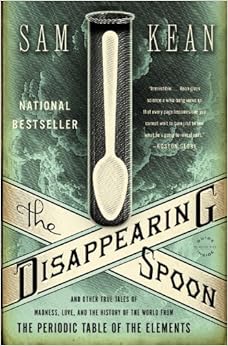
Sam Kean's Disappearing Spoon and my renewed excitement about the periodic table

The Disappearing Spoon by Sam Kean explores the periodic table and the stories behind a variety of elements.  It made me realize how much I had forgotten from my chemistry classes. Of course, it also made me think about how I learned about chemistry in the first place. My high school chemistry teacher, Ms. Simms, was excellent. She had a number of great illustrative methods to think about things like orbitals and electrons. However, despite her superb teaching, I really struggled with chemistry at the time.

My graduate classes in biology always included lots of narratives of the scientific process and how the scientists reached their discoveries. This is a great way to learn about how to think about a problem and how to design experiments properly. It is also an excellent way to learn about science. This book taught me far more about chemistry than I had originally intended.

The story of how the periodic table developed and evolved is a fascinating one. (As an aside, the Radiolab podcast Yellow Fluff did a great story on this as and it serves as a nice complement to sections of this book.) In fact, one of the most interesting stories in The Disappearing Spoon was the biography of Dmitri Mendeleev. Chapter 3 discusses Mendeleev's personal story; my favorite part is how his widowed mother "bundled him on horseback and rode 1200 miles across  the snowy Ural mountains to an elite university in Moscow". While that university did not accept Dmitri, he later found a spot at a university in St. Petersburg. Sadly, his mother died shortly after he was enrolled. Mendeleev excelled in school and worked in lots of different chemistry labs. Using this knowledge, he started to organize the elements; the story goes that Mendeleev used to play a sort of chemical solitaire with the elements written on index cards. 

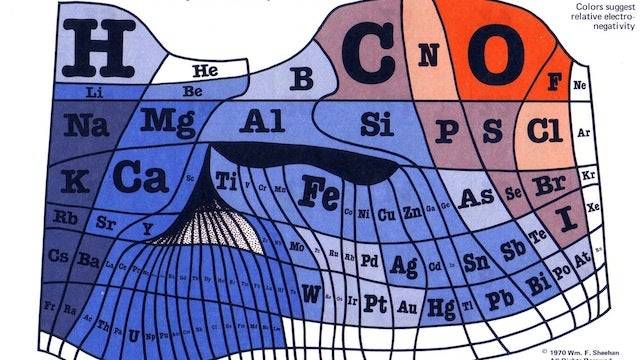
Periodic table according to relative abundance (from io9)
The story surrounding Midas and his golden touch was also examined (Chapter 13- Elements as Money). It seems that Midas' golden touch may have been more of a brass touch. The king's metallurgists thought they were making bronze, an alloy of tin and copper, but in fact were making brass, an alloy of copper and zinc. Thus, the brass had more of a golden tone to it. Indeed, the soil in the area of Asia where Midas once ruled is indeed rich in zinc and present day metallurgists have shown this hypothesis to be a likely explanation for the myth. 

The book explores other topics including how elements are used in times of war. In Chapter 5, Kean talks about the importance of molybdenum (wolfram, W) in the development of Germany's weapons, which were spiked with wolfram to withstand higher heat, in World War I. This chapter also tells the story of Fritz Haber (another great Radiolab episode) as well as the elements that have fueled the conflict in Congo -- tantalum and niobium, which are commonly used in cell phones and other electronics. 

In the end, The Disappearing Spoon, much like Walter White in Breaking Bad, has renewed my appreciation for the periodic table and  helped me understand better some of the things I probably learned 20 years ago. 


A few related links:


For your viewing/listening pleasure, I present They Might be Giants, Meet the Elements.

The dynamic periodic table. I wish they had this kind of thing when I was in school.  


Friday, December 14, 2012

Protein and gene names

There are lots of really great protein and gene names out there.  The Drosophila literature has that novelty in spades.  For example, the cheapdate gene makes flies get tipsy easier than your average fly;  methuselah generates flies that live longer than average; lilliputian flies are quite small.  Based on my post doctoral work, I like diaphanous, the deletion of which causes flies to have wings that are transparent.

In the realm of protein names, I think my favorite may be Shugoshin, which binds to and protects cohesin during cell division; shugoshin is the Japanese word for protector or guardian spirit.  While septin and actin were my favorite proteins when I was in the lab, they are not likely to conjure up any interesting imagery.  I suppose actin has inspired several interesting review titles (e.g. Actin up in the nucleus, Actin' like actin?). The other names that I love are those that give the impression of a gerund spoken with a southern accent.  In my reading today, I came across my new favorite protein name: fidgetin, which is a microtubule severing protein. Other protein names that make me giggle: spastin, profilactin, villin, supervillin. 

In doing a bit of research for this post, I learned that while Sega has no problem with the use of Sonic Hedgehog as a gene name, Pokemon threatened to sue if the gene name was not changed.

Of course, the other end of the spectrum exists. The protein p53 is named simply for the apparent molecular weight on SDS-PAGE.  As a graduate student, I worked with MSP, major sperm protein, named so because it was the major component of Ascaris sperm.

While this practice of creative naming may introduce troubles in creating consistency between species, it certainly can help keep scientists entertained while reading papers.  

Here is a nice list of other gene and protein names from Robert Krulwich.

Wednesday, November 28, 2012

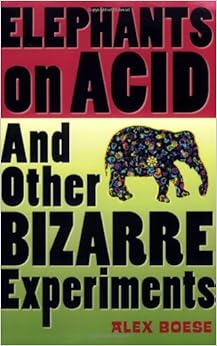
What I've been reading these days: Radioactive by Lauren Redniss and Elephants on Acid by Alex Boese

Since I started working as a Scientific Editor at Elsevier in May, I have found more time for reading for leisure.  I have peppered my reading selections with assorted science writings. First, I quickly plowed through Radioactive: Marie and Pierre Curie: A Tale of Love and Fallout by Lauren Redniss.  Radioactive is a graphic novel that highlights the passion of the Curies for science and for each other.  The book itself was so thoughtfully assembled; for example, the cover glows in the dark, much like Curie's radioactive elements. 

Based on the recommendations of Amazon, I followed up with Elephants on Acid and other Bizarre Experiments by Alex Boese.  Where Radioactive made me long for my old life in the lab, filled with its ups and down and unusual characters, Elephants on Acid was appropriate for my new position as a Scientific Editor. In my evaluation of the papers and the search for appropriate reviewers, I have found myself in some strange corners of PubMed. At one point, I found a paper that examined the effect of LSD to assist in the rehabilitation of alcoholics (Psychedelic Therapy Utilizing LSD in the Treatment of the Alcoholic Patient: A Preliminary Report).  It seems that scientists were very excited about the effects of LSD, thus they tested everything from spiders (The Effect ofLSD-25 on Spider Web Formation) to suburban housewives (see the work of Sidney Cohen).  The titular experiment that tested LSD in elephants was surprisingly repeated by two, independent groups. While the first group seemed to overdose the poor elephant, who subsequently died, the second group found the right dose and reported their observation in the journal Science. 
Boese finds lots of other strange experiments. The ones that I found most interesting were the work of Daniel Simons, which explores the phenomenon of change blindness. These experiments are best watched rather than explained. (http://www.simonslab.com/videos.html)  Other experiments tested questions like: Can people distinguish Coke from Pepsi? Do people get less choosy of whom they will take home from a bar after last call? What does the soul weigh? Of course, the author also explains some rather infamous experiments, including the Stanford Prison Experiment and the Milgram Obedience experiment. However, it is unlikely that experiments like these will cross my desk; rather, I am more likely to see papers that examine the proteomics of horse semen or the effect of vanilla extract (or really anything you can imagine) on cancer cells. 

Thursday, February 16, 2012

Torch song or swan song?

In my research into new directions, I have stumbled upon lots of blog posts just like this one (for example, this and this). They all seem to share a sense of loss.  Indeed, one day in the lab I was listening to some sad music, as I am wont to do on a rainy, gray day, when suddenly, I found myself crying and it took me a while to figure out why: I identified my relationship with science with the heart-sick protagonist in the song. 


My friend and lab mate from grad school often compares work at the bench to an abusive relationship: one in which you are constantly beaten down, but are apt to forget about it once you have one good day.  At the bench, that one good day every few weeks has to carry you through all the dark, data-less days.  For some people, that one day is enough, but it does not seem to be enough for me anymore.


For more than twelve years, my quotidian existence has been built around getting up and heading to the bench.  The idea that I won’t be picking up my pipettes anymore seems strange.  Instead, I suppose my day will be filled with reading the literature, checking the science blogs, and writing and editing.   For the time being, I will be working as a freelance scientific editor.  Of course, I will be looking for more traditional jobs in scientific publishing as well.  I hope that this leaves some time for science writing, which is what I started graduate school with the intent of doing.   


I hope that this change will help return my love to me.  In recent months, I have felt the flutter a few times, usually while reading science blogs.  There is certainly lots of great science out there.  Now I hope to find it from the computer rather than at the bench.       


Update Nov 2013: Looks like someone at Nature had the same thoughts: Postdoc's torch song

Wednesday, February 1, 2012

I am the 80%.

My decision to leave the bench has not been an easy one.  

I have been applying for jobs, and I found myself writing this sentence for my cover letter.  This seems like such a simple sentence.  It feels rather cliché.  It is definitely an understatement.  In reality, the past year has been wrought with tears and anxiety. 

The reason the sentence feels cliché is that it likely is.  The academic bottleneck is a reality that many post docs in science will have to face.  The likelihood of a post doc in the biological sciences landing a job as a PI is pretty low.  In the seventies, 55% of PhD's would have a tenure-track job; in the past decade the number is closer to 20%.   (More cogent articles have addressed this issue, e.g., The PhD problem and The PhD Factory, so I will not belabor the point here.)  Nonetheless, lots and lots of post docs brave the odds and join a lab. What drives PhD's to keep making the leap of faith?  Judging by the behavior of my lab mates, who tirelessly toil away for 60-70 hours a week, it is somewhere between passion and madness.  I recently heard one lab mate, upon being asked what she would do if she weren’t a scientist, reply simply and without a trace of drama, “I would die.”  Is it this simple?  Like an artist or a writer, some people are just called to do this and could not consider an alternative. 

Goodbye bench.
In my case, I feel I was lucky to stumble upon this job in the first place.  As my project comes to a close, I find myself questioning why I ever spent all that time in the lab.  Of course, I was like the others: driven by the pursuit of the answer to my question, in search of the perfect experiment to make the paper that much better.  No matter how sad I get about the fizzle of my project, I try to recall the days when I knew that I could beat the odds and get my own lab and do some really great science.  I am still jealous of those that are living the dream, and I hope that they can make it work.  

For me, I am embarking on a new stage as a science editor and writer. I will be sure to keep this blog updated as I progress.