At the library one day, I stumbled upon a children's book about Gregor Mendel. This gave me the idea to read a collection of books about scientists with my seven-year-old boy. The books highlight the importance of curiosity, perseverance, and troubleshooting in the scientific process.
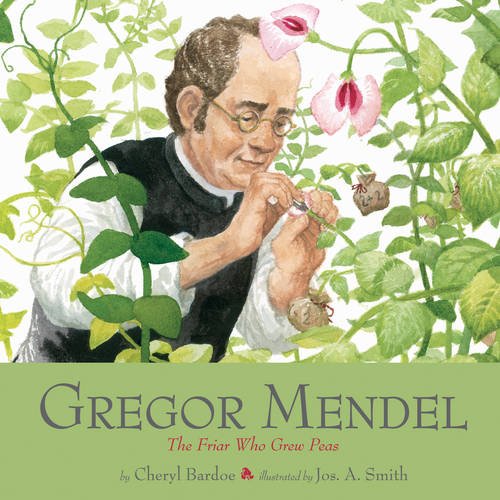 Gregor Mendel - The Friar Who Grew Peas: Like many on this list, the book begins with Mendel's youth, with a focus on his curiosity and his thirst for knowledge. His parents could not afford secondary school for Mendel, so he payed his own way by tutoring other students. He joined a monastery so he could focus on learning and not worry about making a living. While there, he began his famous experiments with pea plants; over the course of eight years, he grew close to 28,000 pea plants. This book was a great stimulus for conversations about genetic, which followed on our discussion from the cilantro experiment. I even learned something about the specifics of his experimental methods and the novelty of his approach of using mathematics to explain his results.
Rosie Revere, Engineer: This was definitely my favorite of the science books we read. Rosie Revere is a second grader who loves tinkering and building inventions. She aims to be an engineer, but is frustrated by the failures of her creations. Luckily, her great Aunt and namesake Rose (formerly known as Rosie the Riveter) helps young Rosie learn that the most important part of engineering is trouble shooting the problems that arise when you build, an important lesson for budding scientists and engineers. I am really looking forward to the author's next book, Ada Twist, Scientist, due out in September 2016.
 Snowflake Bentley: This Caldecott Award winner is a beautiful picture book with woodcuts reminiscent of scenes by Currier and Ives. The style is appropriate for the story of Vermonter Wilson Bentley (b. 1865) whose fascination with snow led him to become an early DIY scientist, setting up a microscope and camera in his parents' barn. I first heard about Bentley on an episode of Radiolab about snowflakes and subsequently found this book during a particularly long visit to the public library during Boston's winter from hell. Like others on this list, the book highlights the importance for scientists to think differently and pursue questions tenaciously.
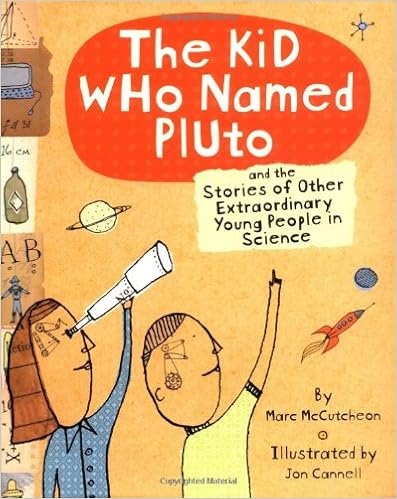
The Kid Who Named Pluto: This collection of stories about kids contributing to science was a mixed bag. While most stories fit the bill, some were tenuous in their connection to the theme. The highlights for us were the story of 11-year-old Venetia Burney, who suggested the name Pluto for our dwarf planet, and the story of Mary Anning, who supported her family by hunting and selling fossils near her home in Lyme Regis, England. Anning had many great finds in her lifetime, including several ichthyosaurs and a pterodactyl. (Shortly after reading this story, I came across this fascinating post about how Mary Anning may be the basis for the She sells seashells tongue twister; always great to see the Baader-Meinhof Phenomenon in action.) I think we will have to find some books that focus on Mary Anning for our next project!
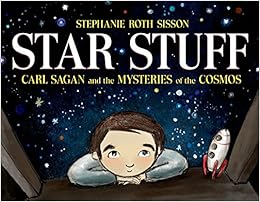 Star Stuff: Carl Sagan and the Mysteries of the Cosmos: Like most Gen X science types, I loved the first Cosmos series as a kid. I later re-discovered Carl Sagan in my early forays into science writing (his book The Shadows of Forgotten Ancestors is on my great science reads list); he made me want to be a science writer myself. Star Stuff book begins with Sagan in elementary school, where his interest in space was spurred in part by science fiction novels. It then details how Sagan started the Cosmos series to share his excitement about learning about the universe. Finally, his role in the U.S. space program, in particular his contribution to the Golden Record on the Voyager spaceships, is described. While we enjoyed this book, I felt it didn't capture the beauty and poetry of Sagan's language.
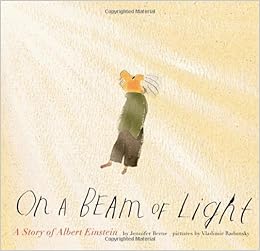 On a Beam of Light - A Story of Albert Einstein: For reasons unclear to me, my son is obsessed with Albert Einstein; I think it might be their mutual love of science and math and a dislike of hair brushes and socks. As most children's books about Einstein, On a Beam of Light begins with his parents worrying about his lack of speech, even at three years of age. When he finally does start talking, he is full of questions, much to the chagrin of his school teachers. The book highlights the importance of curiosity and how asking simple questions can lead to truly profound results.This was a favorite for both of us; I thought it captured the eccentricity of Einstein as well as the practical elements of his personality that made him successful (hardworking and thoughtful).
------------------------------------------------------------------------------
Gregor Mendel - The Friar Who Grew Peas: Like many on this list, the book begins with Mendel's youth, with a focus on his curiosity and his thirst for knowledge. His parents could not afford secondary school for Mendel, so he payed his own way by tutoring other students. He joined a monastery so he could focus on learning and not worry about making a living. While there, he began his famous experiments with pea plants; over the course of eight years, he grew close to 28,000 pea plants. This book was a great stimulus for conversations about genetic, which followed on our discussion from the cilantro experiment. I even learned something about the specifics of his experimental methods and the novelty of his approach of using mathematics to explain his results. |
The Kid Who Named Pluto: This collection of stories about kids contributing to science was a mixed bag. While most stories fit the bill, some were tenuous in their connection to the theme. The highlights for us were the story of 11-year-old Venetia Burney, who suggested the name Pluto for our dwarf planet, and the story of Mary Anning, who supported her family by hunting and selling fossils near her home in Lyme Regis, England. Anning had many great finds in her lifetime, including several ichthyosaurs and a pterodactyl. (Shortly after reading this story, I came across this fascinating post about how Mary Anning may be the basis for the She sells seashells tongue twister; always great to see the Baader-Meinhof Phenomenon in action.) I think we will have to find some books that focus on Mary Anning for our next project!
On a Beam of Light - A Story of Albert Einstein: For reasons unclear to me, my son is obsessed with Albert Einstein; I think it might be their mutual love of science and math and a dislike of hair brushes and socks. As most children's books about Einstein, On a Beam of Light begins with his parents worrying about his lack of speech, even at three years of age. When he finally does start talking, he is full of questions, much to the chagrin of his school teachers. The book highlights the importance of curiosity and how asking simple questions can lead to truly profound results.This was a favorite for both of us; I thought it captured the eccentricity of Einstein as well as the practical elements of his personality that made him successful (hardworking and thoughtful). ------------------------------------------------------------------------------