Wednesday, June 22, 2016

Publishing your scientific paper: tips and tricks from a scientific editor

I have written several posts about my work as a scientific editor, but I haven't talked about performing institutional visits, which I sometimes combine with an author workshop discussing the publication process. At Elsevier, these author workshops are given by many different people across the company and they start with the title "How to Publish in Scholarly Journals". Over time, my talk has evolved to focus on the scientific editor's perspective on the publication process; I try to give the audience my pro-tips for navigating peer review from start to finish. The major theme of my talk is making it easy for people to read and interpret your paper: first, the journal's editors (who you want to send it out for review), then the reviewers (who you want to review it fairly and favorably), and finally the readers (who you want to read the paper so they can cite it). I have given this talk enough times that it is starting to feel like my own. I even have a couple of good zingers, including one about the authors who requested that no one from Japan review their paper (obviously we could not satisfy that exclusion request).*

Every time I give this talk, I refer to several online resources that I have found useful in putting together my slides.** Because my blog audience is much broader than my typical seminar audience, I decided to put together a collection of the best of these resources in combination with some of my own tips. 


General Tips: 
Preparing your Manuscript:
Preparing your Figures/Image Manipulation Policies: 
Revisions and Rejections: 
Getting Your Paper Noticed: 
  • After your paper is published, remember to share your work with others and follow how your paper is doing. 
  • First, you might want to read this post on Scholastica about why this is important.
  • Elsevier's Publishing Campus has additional tips and tricks
  • Altmetric and Mendeley Stats can help you gauge the impact of your article before citations start. 

*********************

* The Tufts Post doc association has a blog post about my visit.

** I recently noticed that I refer frequently to the Cell Press CrossTalk blog in my author talk. While I work for the same company as the Cell Press folks, I do not actually receive any click-through dividends. It just happens to be a great site with many useful posts.

Friday, June 3, 2016

The complex legacy of James Watson

Watson & Crick with their DNA model

James Watson was something of a wunderkind. He started college at age 15 and was only 24 when he published the structure of the DNA double helix with Francis Crick in April 1953. From the beginning, the DNA project was a hotbed of controversy and rivalries. The biggest controversy surrounded Rosalind Franklin and her X-ray crystallography image Photograph 51. Essentially, Watson took Franklin’s data without her permission; the image was the lynch pin in decoding the DNA double helix. This discovery was the basis for his Nobel Prize in medicine in 1962.


Goldblum as Watson in
The Race for the Double Helix
Watson has always been a polarizing figure in molecular biology. He was brash, arrogant, and oftentimes sexist; to give you a sense of his character, he was played adeptly by Jeff Goldblum in The Race for the Double Helix in 1987.  His Wikipedia entry includes a laundry list of controversial comments, which run the gamut of racism, sexism, classism, and homophobia. His comments in 2007 were the final straw for his career; he said "[I am] inherently gloomy about the prospect of Africa [because] all our social policies are based on the fact that their intelligence is the same as ours—whereas all the testing says not really." Those comments caused him to lose many of his academic appointments and speaking engagements. The biggest loss to Watson was his position as chancellor at the Cold Spring Harbor Laboratory (CSHL); he did stay on at the CSHL in an emeritus position.

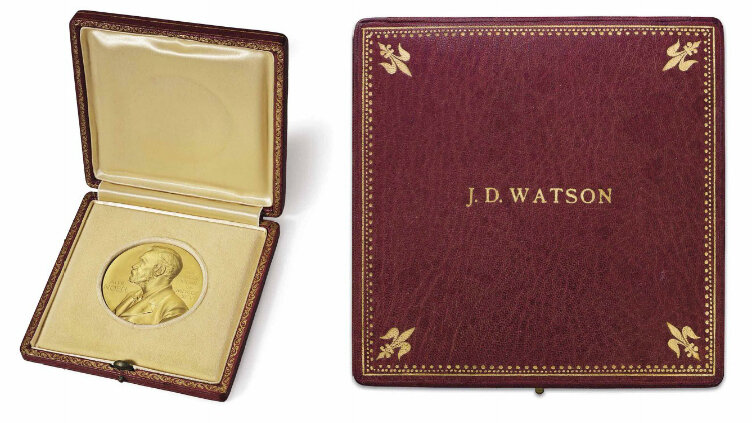
Watson later attempted to distance himself from the comments, saying that he is not racist “in a conventional way”, but the damage was already done. In 2014, Watson made headlines with his decision to auction off his Nobel Prize medal, which was the first time in history the medal from a living Nobel winner would be sold. Watson claimed that his comments made him “an unperson”. He planned to sell the medal to return to public life, donate to the scientific research institutes that made his career, and maybe buy a David Hockney painting. The medal sold for $4.1 M to a Russian billionaire Alisher Usmanov, who later returned the medal to Watson with the caveat that a portion of the money should be donated to science (no mention of the Hockney painting). In the end, while Watson succeeded in getting his cash flow problem resolved, he was unable to erase the damage his controversial comments had done.

Out of curiosity, I decided to investigate the other side of the story. Of course, it was rather difficult to find people who defended Watson and his behavior (I refuse to link to those defenses that are based on the idea that Watson was just another victim of the PC police). One defense I read suggested that Watson's behavior could be explained by his over reliance on science to solve the problems of the world. I find this conclusion unsatisfying. Rather, I prefer the idea, that Watson cultivated an image as a gadfly or a loose cannon, but the quality that he once cultivated became part of his nature.

Honestly, this character has generally been good for his career. If you look at his publication record, it was not nearly as strong as Franklin's or Crick's. And yet, he was chosen as the head of the CSHL and as a figure head for the Human Genome Project. Despite his decries of being "an unperson", he still contributes opinions to various platforms and is called for comment on stories in the New York Times (most recently in this great piece about Otto Warburg, which I frankly felt did not need his contribution). In addition, you can still find the occasional mention of him giving lectures (most recently at Harvard in Feb 2016, where he lectured on how to achieve success). 

The legacy of James Watson shows us how an accomplished scientist can still be an awful person. While most scientists I know still get excited to see the old man shambling about during summer meetings at Cold Spring Harbor, they know it is best to avoid talking to him.

***
This post is based on something I put together for a post on r/redditdayof on the theme of "Watson".

Additional Sources: Opinion from scientist Adam Rutherford in The Guardian; Slate article Watson Throws a Fit

Sunday, May 22, 2016

Using cilantro's foul flavor to teach my son about human genetics

We are struggling to incorporate variety into the diet of our seven year old, who is not interested in having anything green on his plate. My husband, the cook of the house, has found some ingenious ways to sneak extra veg into dishes (e.g., finely chopped cauliflower disguises itself as meat in chili con carne). My contribution to this effort has been to tackle the problem with a little home-based scientific investigation. (I guess my scientific training is helping my parenting skills as well as my baking skills.) How random genetic variations can affect taste perception was one of the many interesting topics in both Sharon Moalem's Inheritance and Sam Kean's The Violinist's Thumb. Like most couples, my husband and I have some major differences in how some foods taste. This gave me the idea of using these genetic variations to our advantage to talk to our son about human genetics and genetic diversity.

Thamizhpparithi Maari (CC-BY-SA) Wikimedia Commons
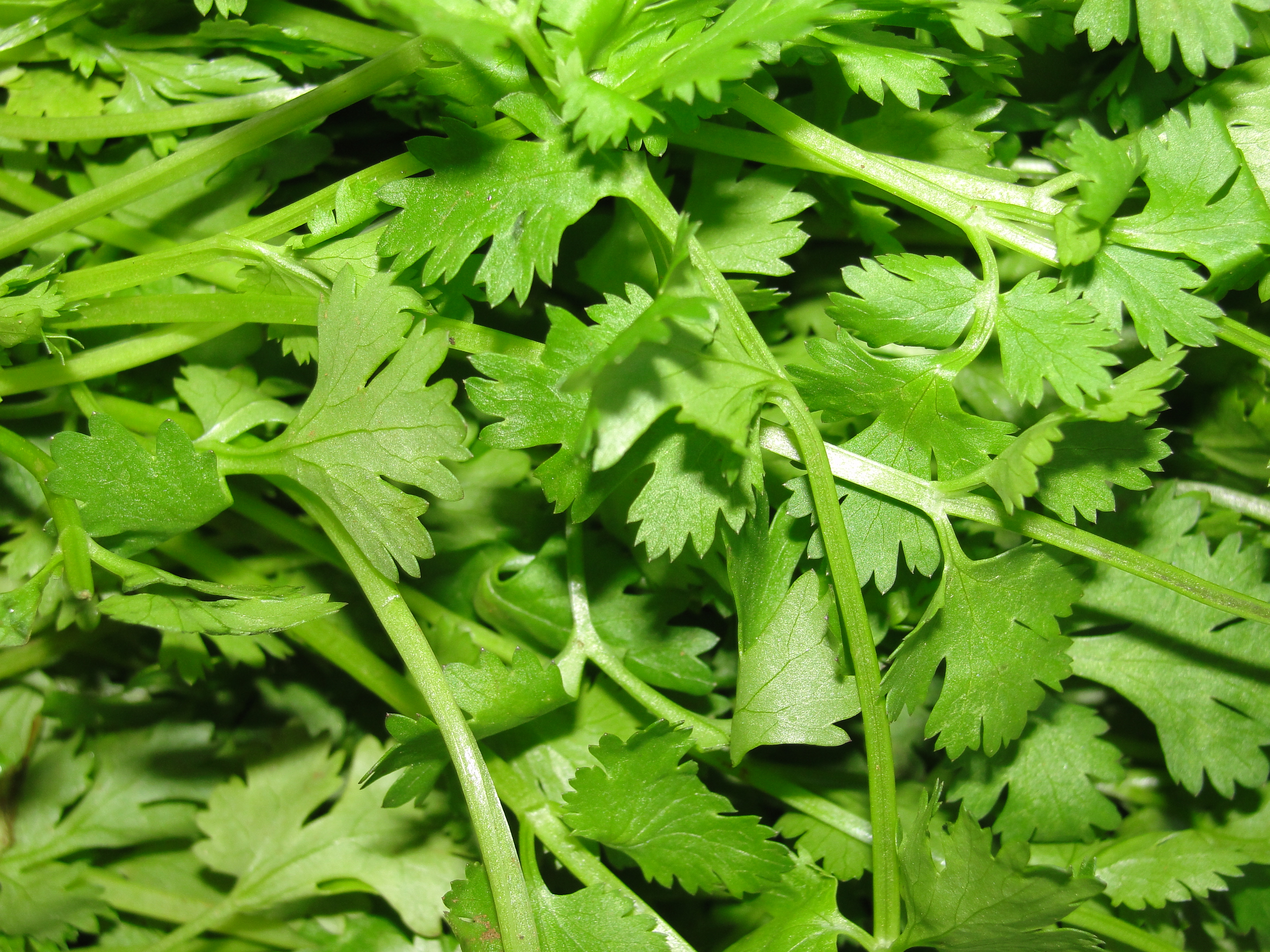
I had previously introduced my son to the concept of DNA with Have a Nice DNA, a fun book from Cold Spring Harbor Laboratory Press suitable for elementary-aged children. This set the table for the first experiment: cilantro (or coriander). I find that cilantro tastes a bit soapy, but my husband thinks it tastes great. Before our dinner of black beans and rice with raw cilantro sprinkled on top, I told our son about the differences in how his father and I perceive the taste of this herb. I told him that he would be part of an important experiment to determine whose genes he had inherited. In the spirit of the good nerd we are raising, he was fascinated and curious. The experiment revealed that our son had not inherited my taste perceptions of cilantro. In fact, it made him laugh to hear that I thought it tasted like soap (kids love to see their parents suffer), especially since it was so different from what he thought it tasted like.

Once we learned the outcome, I wanted to teach him more about the genetic basis of this difference. Lucky for me, cilantro is a hot topic on the internet. The prevalence of dislike ranges from 3-21% depending on the ethnic group (21% of east Asians, 17% of Caucasians, 4% Hispanics, and 3% Middle Easterners). While in the minority, the group is quite vociferous in their hatred of the herb. The consumer genetics company 23andme looked at DNA sequence data for ~30,000 users who were asked about their preference for cilantro. Variations in a gene called OR6A2 were linked to differences in cilantro preference. This gene encodes an olfactory receptor that recognizes certain aldehydes, which happen to be the molecular basis of cilantro's smell. Aldehydes are also present in soap. Thus, people with the genetic variant are more likely to sense cilantro's soap-like aldehydes; the sense of smell is a major player in how we perceive flavor. Two other studies found two different explanations for the soapy phenotype (one showed a connection to a different olfactory receptor and the other to a bitter taste receptor); these differences in results could be due to the large variation in the phenotype. My literature searches did not find any more recent stuies in the genetics of cilantro taste perception, suggesting that the work is difficult to fund.

I think my favorite find in my exploration of cilantro was the Gastropodcast, which examined the science behind these differences. Another interesting piece was from New York Times food science writer Harold McGee, who explored the evolutionary basis for taste perceptions. He also discussed how changing the preparation of cilantro can change its flavor; one study showed that crushing cilantro speeds the rate at which plant enzymes break down aldehydes. As a result, fine chopping of cilantro or cooking it a bit can get rid of the soapy flavor for some (this definitely works for me). Based on the success of the cilantro experiment, we will definitely be searching for future food science to explore during family dinners.

Thursday, March 31, 2016

How my PhD training has improved my baking skills

I walked away from the bench four years ago this month. Since that time, I have enjoyed the life of a Scientific Editor, where my training in the lab is integral to the job. I am still surprised when my training becomes useful in everyday life. Perhaps it shouldn't –  many articles about "The PhD Problem" focus on how training to be a scientist has other long-term benefits, including developing critical thinking and problem solving skills. A few years ago, I decided that I would start approaching recipe development like I would designing a protocol or experiment. This has been a very fun project, so I wanted to share my results.

First, I started reading more about recipe development by professional bakers. Then, I decided to tackle my favorite baked good: the oatmeal cookie. For many years, I have used my mom's recipe, which came from the Quaker Oats box and was never altered. They are delicious cookies, but as any scientist/baker would, I wondered if I could do better.


I had to figure out what recipe to start with. The Flour cookbook has a great oatmeal cookie recipe, with excellent instructions that are thoughtful about the science of baking (e.g., the formation of gluten). Another advantage is that their recipe includes weights for all the ingredients. The use of a scale to weigh ingredients was a crucial element for my recipe testing – it added precision and allowed me to make half a recipe (this meant I could bake cookies every other weekend without having too many extra calories). The Flour cookies are very good, but I found them too chewy and I wanted more oatmeal. I did some more research on how each ingredient in a cookie recipe contributes to the end result. (The best resource was The Food Lab.) Over the course of a year, I baked four different iterations of the Flour recipe and ended up with something in between their recipe and the original Quaker recipe. I have repeated this protocol six times and find it is consistently good – even after we moved (testing a new oven) and got new cookie sheets. Out of curiosity, I did try America's Test Kitchen recipe (free version here), as ATK is the gold standard of recipe testing. I found their cookie had a good oat flavor, but was too crunchy and crumbly. 
This experiment taught me a lot about recipe design and the small things that make a big difference in how cookies turn out (e.g., letting the dough rest overnight). I also found many useful resources to help me in future recipe development. It is definitely a great time to be a scientist/baker as there are so many food blogs and podcasts that focus on this topic. The success of my experiment and the wealth of resources available has encouraged me to approach my previously perfected "Test Kitchen Brownies". I will be sure to update you once my next experiment is complete.

Thursday, February 11, 2016

DIY Science: Biopunk by Marcus Wohlsen shows how to do science away from the bench

I have read many stories about doing science away from the bench, both in the news and views section of scientific journals and on popular science blogs. PLOS Blogs even has a regular feature called Citizen Sci, which highlights how everyday people can take part in science outside the traditional laboratory or field setting. Thus, I was curious to read Biopunk: DIY Scientists Hack the Software of Life by Marcus Wohlsen.

Wohlsen did a great job of discussing what DIY science is and why it is important. Historically, the roots of DIY science can be found in people like Edward Jenner, who inoculated his gardener's son with cowpox to test its efficacy against smallpox and Newton, who poked himself in the eye to better understand optics. Today, the DIY science movement serves to democratize science, allowing people outside of research institutes and universities to take on projects based on their own interests rather than based on the decisions of funding bodies. As a result, the movement could transform science, taking some power away from the big companies that set steep prices for lab equipment.

One major goal of the DIY science movement is to MacGyer common lab equipment to make it accessible (read: cheap) to everyone. Some of these hacks could serve researchers that aren't lucky enough be in a well-funded lab. Take the example of the PCR machine, the biology lab workhorse that helps researchers copy and manipulate DNA (prices start at $3000). A Google search for "DIY PCR machines" reveals many designs that start at $100, making PCR available to more people. Thus, many of the projects in DIY biology can benefit the developing world because they are design to cut costs and to make it possible to run experiments in virtually any environment.

One element that seems to be common in every story about DIY biology is the comparison with the computer hacking movement. People turning spare rooms and garages into laboratories for their side projects does have similarities with the origin stories of companies like HP and Apple. The resemblance goes further: DNA is the code of life and, like computer hackers, people in the DIY bio movement believe that this code should be open source and not limited only to the scientists who have grant money or research labs. Labeling DIY scientists as "hackers" can create a negative impression; when the general public hears of a hacker doing genetic modification in their garage, there can be a tendency to overreact. The worst case was seen with Steve Kurtz, an artist that used the tools of DIY biology as part of his palette. In 2004, Kurtz was arrested on suspicion of bio-terrorism after his wife died of an unrelated heart attack. (There is also an interesting documentary about the case called Strange Culture.)

Wohlsen pushes the idea that DIY scientists are punks, describing their leather jackets, tattoos, and Mohawks, to the point that borders on fetishization of his interview subjects. To some extent, this is SOP in science writing (and celebrity interviews); it serves as a device to quickly characterize the subject. Unfortunately, it detracts from the serious science that is starting to happen. I look forward to seeing what DIY bio leads to in the future, especially because CRISPR technology has made genome editing simpler and cheaper than ever and it is readily available to DIY biologists.

Another great aspect of DIY science is that it can give the people who left the lab after their PhD or postdoc a way to return to the excitement of scientific discovery. Depending on where you live, you may find a hacker space near you. Here in Boston, you can visit the BossLab (Boston Open Source Science lab), but most major cities seem to have similar spaces available. Some more great resources can be found at DIYbio.org. Of course, I think I will keep my home experiments confined to baking. 

Monday, November 30, 2015

Culturing Life reveals the history of tissue culture, with some interesting details about HeLa cells

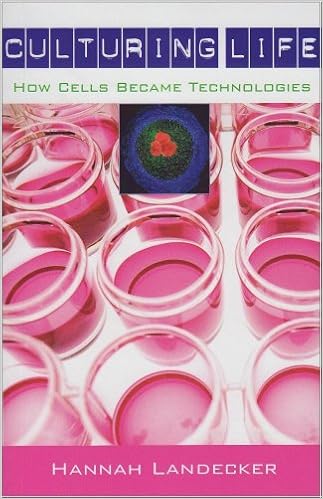
Culturing Life: How Cells Became Technology by Hannah Landecker is an extensive history of the culturing of cells in the lab. As such, it gave many details about the fits and starts involved in the early attempts to get cells to grow reliably. As is usually the case in scientific research, as much is owed to timing and serendipity as to careful repetition and fastidious lab work.

The idea that cells could be taken from an organism and cultured separately was initially met with skepticism. The general thinking was that cells could not become autonomous from the organism. By 1885, Wilhelm Roux showed that he could keep nerve cells from chicken embryos alive for several days in the lab. Once the principal was established, scientists began to search for the right media, the right glassware, and the right cells or tissue to make cell culture reliable.

The growth in virology was a major driver for the improvement of cell culture. Virologists needed a way to make large-scale cultures of infected samples for vaccine development. Early vaccines were grown using embryonated chicken eggs, a method that had a high yield for virus, but was quite costly. (Flu vaccines are still made using chicken eggs; the specifics of the process are described here.) By the 1930s, the yellow fever vaccine was the first to be produced with cultured cells, but it was not clear that these approaches would work for other viruses.

Alexis Carrel used specially designed flasks for growing cells
In the late 1940s, John Enders started using cell culture to grow viruses. His lab was the first to show that polio virus could be cultured in human tissues and that infection with the virus caused rapid changes in the appearance of the cells; these results meant that there was a quick and reliable assay for infection. Enders published his results in the journal Science in 1949 and soon after received the Nobel prize for his work.

It is important to consider Enders' work in the context of time and place. As Landecker writes, "It is not that Enders was particularly good at growing human cells." Instead, like so many scientific breakthroughs, Enders' success was due to being in the right place at the right time with the right reagents. The location of his lab in Boston Children's Hospital afforded Enders a ready supply of living tissues (from abortions, miscarriages, hysterectomies, and circumcisions, which were all used without concerns about patient consent or privacy). The timing was also critical as cell culture was becoming more feasible due to improved techniques and the increased availability of antibiotics. Enders' methods became the basis for the production of virus cultures for vaccine development, most significantly the creation of polio vaccine by Jonas Salk in 1954.

Importantly, Enders and Salk also had a major role in organizing the tissue culture community. One major push was for standardization of reagents and media; in the early days of cell culture, each lab made its own glassware and media, so it was nearly impossible to share cell lines between labs. Another proponent of standardization was cell biologist and electron microscopist Keith Porter. Porter wanted to image whole cells by EM, but was frustrated by the need to learn the exacting and often finicky methods of cell culture to get his experiments done. Porter and others started a group that would later become the Tissue Culture Association, which aimed to standardize media preparation and other elements of tissue culture.


The next major event in the history of cell culture happened in 1951, when an African-American patient named Henrietta Lacks was treated for cervical cancer at Johns Hopkins. Lacks' biopsy came into the hands of George Gey, who was able to generate the first human cell line (called HeLa cells) that in culture continuously. HeLa cells are unique in many respects: they grow rapidly and are robust enough to withstand shipping and freeze/thaw cycles. These unique features (which have been explained to some degree by the genome sequence) were what allowed researchers to culture the cells so easily, making HeLa cells a standard cell line in most laboratories.

The story of the origins of the cell line that was generated from Ms. Lacks' biopsy has been told in beautiful detail by Rebecca Skloot in The Immortal Life of Henrietta Lacks. Skloot's book (which is on my list of top science reads) focuses on the Lacks family as it comes to terms with the Henrietta's legacy. In Culturing Life, Landecker tells the HeLa story in broader strokes with a different historical context, focusing on how the tenor of the HeLa cell line origin story has changed over time. In 1968, with tissue culture techniques established and many cell lines available, Stanley Gartler published a Nature paper profiling eighteen cell lines; using the presence of a gene variant only present in African Americans, he showed that all were contaminated by HeLa cells. Predictably, these results created a major stir in the research community. Landecker details the language used to describe HeLa cells, particularly in regards to the contamination issue: aggressive, surreptitious, and malicious. Some scientists suggested that "one drop was enough" to contaminate and ruin a culture, which is evocative of the one-drop rule of racial classification in the US. Thus, unlike for most cells, the race and gender of the donor was central to the discussion of the cells.

While the language used to talk about HeLa cells has changed considerably, some elements have remained consistent. Scientists and science writers still connect the cells with Henrietta Lacks and talk about how the cells have allowed her to achieve immortality. Most articles will also detail how many HeLa cells have been grown since Gey started to culture the cells. Indeed, these are fascinating details. According to Skloot's book, "One scientist estimates that if you could pile all HeLa cells ever grown onto a scale, they’d weigh more than 50 million metric tons—an inconceivable number, given that an individual cell weighs almost nothing. Another scientist calculated that if you could lay all HeLa cells ever grown end-to-end, they’d wrap around the Earth at least three times, spanning more than 350 million feet." Thus, while the legacy of HeLa cells may be complicated, their utility in the research lab is not.

Wednesday, October 7, 2015

Frankenstein's Cat by Emily Anthes looks at how genetic engineering is changing the animals around us


Frankenstein's Cat: Cuddling up to Biotech's Brave New Beasts by Emily Anthes explores how biotechnology and genetic engineering are changing the animals around us. The book delves into the science behind these new creatures as well as the ethical issues and public perceptions. The result is an easy and interesting read that makes you imagine the genetically engineered animals that could be on the horizon.


GloFish were the first commercially available pets created using biotechnology. By inserting the gene that makes jellyfish glow (green fluorescent protein, or GFP) into a common pet store find (zebrafish), the inventor was able to create a fish that glowed green in certain lights. Despite seeming relatively benign, the company was required to perform extensive research on the possible environmental impacts in case of escape before GloFish were approved for sale in 2003. Interestingly, consumers had few concerns about these new creatures and were willing to pay almost 20 dollars for each fish. The company now has a variety of other colors and species available and sells special tanks to help you enjoy their fluorescent fish.

Pharming is a branch of biotechnology where researchers use farm animals to produce a range of pharmacological products. For example, goats can be engineered to produce the protein lysozyme in their milk. Lysozyme has been shown to inhibit bacterial growth; some preliminary results suggest that the lysozyme-enriched milk can improve the immune system. The scientists behind this project hope that this goat milk could help protect children from bacterial infections. Similar approaches have been used to engineer goats that have silk protein in their milk and silkworms that make collagen instead of silk. These additives are not harmful to the animals and have a range of potential applications.

The chapter on animal cloning starts with Dolly the sheep (the first cloned animal) and makes some interesting stops along the way. The story of Carbon Copy (CC), the first cloned cat (sometimes called Copy Cat), is scientifically notable because CC doesn't look much like her calico mother Rainbow. This is due to a process called X chromosome inactivation (you can learn more about this process in my recent post on Junk DNA). The gene for orange fur is on the X chromosome. CC's genome has an inactive copy of the X chromosome from her clone mother. Thus, while CC is genetically identical, she is phenotypically different. This result was interesting to scientists, but it likely gave future customers of cat cloning some pause–what's the point of paying to have your favorite cat cloned if you can't be sure you will get a cat that looks the same?

Anthes tours a wildlife preserve and research center in Louisiana where researchers aim to develop and perfect methods for cloning animals with the long-term goal of preservation of endangered species. This is certainly worthwhile goal, but the barriers, both technical and ecological, are numerous. To me, the biggest problem with saving a species through cloning is the lack of genetic diversity. Until these problems are solved, many are banking on frozen zoos, large stocks of samples from a variety of animals that are endanger of extinction. The hope is that once cloning technology improves, it may become viable to add to the existing populations.

Roboroach from Backyard Brains
The chapter on cyborg animals was truly fascinating. For example, Anthes talks about the CIA's experiments with remote-controlled cats. Project Acoustic Kitty was predictably a failure due to the fiercely independent nature of cats. There are some notable success stories with insect cyborgs. In fact, for 99 dollars, you can build your own Roboroach. The newest approaches include the use of optogenetics, where specific neurons are made to be light sensitive, allowing researchers to control animals by shining a light. These experiments have some important applications, such as the removal of land mines and the detection of survivors in earthquake rubble, but people find animal mind control to be unsettling (even if it is a roach). It is important to consider that.

The book concludes with predictions of what may be possible in the future, like creating farm animals that are resistant to disease to decrease the use of antibiotics. Frankenstein's Cat was published in 2013 and the field has made amazing progress since that time. With the advent of the new genome editing technique CRISPR, the possibilities are truly endless, which has led to concerns about the ethical and safety considerations of this technology. Earlier this week a Chinese Institute caused a stir with its announcement of the commercial availability of gene-edited micro-pigs as pets. It will be interesting to see where we draw the line on genetically modified animals.